

Juniper New 2026 JN0-364 Sample Questions Reliable JN0-364 Test Engine
Feel Juniper JN0-364 Dumps PDF Will likely be The best Option
NEW QUESTION # 32
You have configured an MPLS LSP that begins on R1 and terminates on R5 using the Junos default settings.
Referring to the exhibit, which router will perform only label swap operations?
- A. R1
- B. R4
- C. R5
- D. R3
Answer: D
Explanation:
In an MPLS network, routers are categorized by their role along a Label Switched Path (LSP). In this scenario, the LSP originates onR1 (Ingress LER)and terminates onR5 (Egress LER). Between these two endpoints are the Provider (P) routers, also known as Transit Label Switching Routers (LSRs), which include R2, R3, and R4.
To identify which router performsonlylabel swap operations, we must look at the standard Junos data plane behavior:
* R1 (Ingress LER):Performs aPushoperation. It receives native IP traffic from Networks 1 or 2, looks up the destination, and imposes (pushes) an MPLS label onto the packet before sending it to R2.
* R2 and R3 (Transit LSRs):These routers perform aSwapoperation. They receive a labeled packet, look up the incoming label in their Label Forwarding Information Base (LFIB), replace it with an outgoing label provided by the downstream neighbor, and forward it.
* R4 (Penultimate Hop):By default, Junos usesPenultimate Hop Popping (PHP). Because R4 is the second-to-last router before the egress (R5), the egress router R5 advertises an "implicit-null" label (Label 3) to R4. This instructs R4 to perform aPopoperation-removing the MPLS label entirely-and sending the native IP packet to R5.
* R5 (Egress LER):Receives the packet (which is already unlabeled due to PHP) and performs a standard IP route lookup to reach the final destination in Network 3 or 4.
Among the options provided,R3is the only router that is a transit LSR butnotthe penultimate hop. While R2 also performs a swap, it is not an option. R4 performs a Pop (due to PHP), R1 performs a Push, and R5 performs an IP lookup. Therefore, R3 is the correct answer as it solely performs the label swap operation.
NEW QUESTION # 33
During OSPF neighbor establishment, which packet type is used to describe the contents of the link-state database?
- A. Link-State Request (LSR)
- B. Database Description (DBD)
- C. Hello packet
- D. Link-State PDU (LSP)
Answer: B
Explanation:
In theOSPF (Open Shortest Path First)protocol, ensuring that all routers within an area have a synchronized Link-State Database (LSDB)is fundamental to building a consistent loop-free topology. During the adjacency formation process-specifically when transitioning from theExStartstate to theExchangestate- routers must determine what information they are missing from their neighbors without sending the entire database at once, which would be highly inefficient.
TheDatabase Description (DBD)packet, also known as a DDP, is the mechanism used for this summary exchange. According to Juniper Networks technical documentation, the DBD packet does not contain full Link-State Advertisements (LSAs). Instead, it contains only theLSA headers, which include the LSA type, the ID of the advertising router, and the sequence number.
By exchanging these headers, a Juniper router can compare the neighbor's database summary against its own local LSDB. If the router identifies a header in the DBD packet that represents a newer or missing entry, it records that LSA in its "Link-State Request List." This collaborative "handshake" ensures that only the necessary, updated information is requested in the subsequentLink-State Request (LSR)phase. It is important to distinguish this from theLink-State PDU (LSP)mentioned in Option D, which is actually the term used in the IS-IS protocol, not OSPF. In OSPF, the functional unit is the LSA, and the transport vehicle for the initial summary is the DBD packet. This methodical synchronization is what allows OSPF to scale effectively in large service provider environments.
NEW QUESTION # 34
What is the default export behavior of IS-IS in the Junos OS?
- A. to export nothing
- B. to export only external routes
- C. to export all learned prefixes
- D. to export only IPv6 routes
Answer: A
Explanation:
In the Junos OS, routing policy behavior is governed bydefault import and export rulesthat vary significantly between different protocols. ForIS-IS (Intermediate System to Intermediate System), the default export policy is "reject all." This means that, by default, an IS-IS process willexport nothingfrom the routing table into the IS-IS database.
According to Juniper Networks technical documentation, IS-IS automatically advertises its own direct interfaces that are configured under the [edit protocols isis] hierarchy. However, it does not automatically redistribute routes learned from other sources-such asStatic routes,OSPF, orBGP-into the IS-IS domain.
This is a safety mechanism designed to prevent accidental routing loops or the flooding of unnecessary prefixes into the link-state database (LSDB), which could impact the stability of the SPF (Shortest Path First) algorithm.
To move routes from the routing table (inet.0) into IS-IS, an administrator must explicitly create arouting policyand apply it as anexport policywithin the IS-IS configuration. For example:
Code snippet
set policy-options policy-statement REDIST-STATIC term 1 from protocol static set policy-options policy-statement REDIST-STATIC term 1 then accept set protocols isis export REDIST-STATIC Without such a policy, the IS-IS LSPs (Link-State PDUs) will only contain information about the IS-IS enabled interfaces and the reachability of other IS-IS neighbors. This behavior contrasts with protocols like BGP, which has different default rules for exporting active BGP routes to EBGP peers. In the context of IS-IS in a Juniper environment, "export nothing" is the standard operational baseline.
NEW QUESTION # 35
What information is determined by using the AS path attribute included in the BGP update message? (Choose two.)
- A. the shortest AS path to reach a prefix
- B. the origin of a route from IGP or EGP
- C. the total number of next-hop devices to reach a prefix
- D. the presence of a routing loop
Answer: A,D
NEW QUESTION # 36
Which two events cause a static route to be removed from a routing table? (Choose two.)
- A. Hosts two hops away become unreachable.
- B. The outbound interface becomes unavailable.
- C. The route is manually removed.
- D. The route has no traffic for 30 days.
Answer: B,C
Explanation:
In Junos OS, astatic routeis a manually configured entry in the routing table. Unlike dynamic routes, which have built-in timers and aging mechanisms, static routes are generally "permanent" as long as their conditions for validity are met.
1. Manual Removal (Option A):
Since static routes are explicitly defined by the administrator, the most direct way to remove one is through a configuration change. Using the delete routing-options static route <prefix> command followed by a commit will immediately remove the route from the Routing Information Base (RIB).
2. Next-Hop Reachability (Option B):
For a static route to be "active" and installed in the forwarding table, itsnext-hop must be reachable. If a static route points to a specific physical interface or an IP address on a local segment, and thatoutbound interface becomes unavailable(e.g., the link goes "Down"), the Junos kernel detects that the next-hop is no longer viable. Consequently, the route is marked as "hidden" or "inactive" and is removed from the active forwarding table to prevent traffic from being black-holed.
Why other options are incorrect:
* Aging (Option C):Static routes do not have an expiration timer based on traffic. Even if no packet is sent for years, the route remains as long as the interface is up.
* Remote Reachability (Option D):Standard static routes only track the status of the local interface or the immediate next-hop. They do not possess "end-to-end" visibility. If a host two hops away fails, the local router has no way of knowing this via the static route itself. To achieve this level of tracking, features likeRPM (Real-time Performance Monitoring)orBFD (Bidirectional Forwarding Detection)must be linked to the static route.
NEW QUESTION # 37
Which IS-IS packet type will establish and maintain neighbor relationships?
- A. partial sequence number PDU
- B. update PDU
- C. link-state PDU
- D. hello PDU
Answer: D
Explanation:
In theIS-IS (Intermediate System to Intermediate System)protocol, communication between routers is performed usingProtocol Data Units (PDUs). To discover neighbors and maintain adjacencies, IS-IS relies on theHello PDU (IIH - IS-IS Hello).
According to Juniper Networks technical documentation, when IS-IS is enabled on an interface, the router begins transmitting Hello PDUs to a multi-destination address (multicast). These PDUs contain essential information such as the router'sSystem ID, its configuredArea Addresses, and itsLevel capability(Level 1, Level 2, or both). For two routers to become neighbors, they must exchange these Hello PDUs and agree on specific parameters, such as the MTU of the link and the hello/hold timers.
Once an adjacency is established, the Hello PDU serves as a "keepalive" mechanism. If a router stops receiving Hello PDUs from a neighbor for a duration exceeding theHolding Time, it assumes the neighbor is down and flushes the associated Link-State PDUs (LSPs) from its database.
To clarify the other options:
* Link-State PDU (Option A):These are used to distribute actual topology and reachability information, not to form adjacencies.
* Partial Sequence Number PDU (Option C):PSNPs are used on point-to-point links to acknowledge the receipt of LSPs or to request missing LSPs.
* Update PDU (Option D):This is not a standard IS-IS term; in IS-IS, updates are handled via the flooding of LSPs.
NEW QUESTION # 38
Exhibit: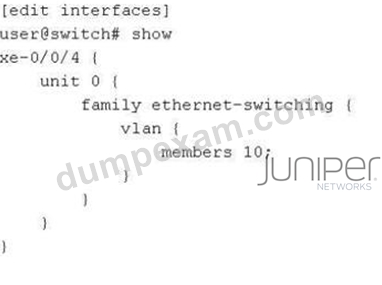
on a Juniper switch. It shows interfacexe-0/0/4withunit 0andfamily ethernet-switching. Under vlan, it lists members 10;`] Referring to the exhibit, which two statements are true? (Choose two.)
- A. The interface is a part of a VLAN that uses VLAN ID 10.
- B. The interface receives untagged traffic.
- C. The interface is a member of the VLAN named 10.
- D. The interface receives tagged traffic.
Answer: B,C
Explanation:
In Junos OS for switching platforms, an interface is configured for Layer 2 bridging under thefamily ethernet- switchinghierarchy. The way an interface handles VLAN traffic depends on its port mode:accessortrunk.
According to Juniper Networks technical documentation, when an interface is configured simply with members <vlan-name/id>, it defaults to anaccess port. In an access port configuration:
* The port is a member of only a single VLAN.
* The portreceives and sends untagged traffic (Option C). Any untagged frame arriving at this interface is implicitly associated with the configured VLAN member.
* The interface does not expect or process 802.1Q tags in incoming frames.
In the exhibit, interface xe-0/0/4 has members 10;. In Junos, the members statement can reference either a VLAN nameor aVLAN ID. However, when the configuration is shown as members 10; without further context of the specific ID mapping, the most precise interpretation of the CLI output provided is thatthe interface is a member of the VLAN named 10 (Option D). While "10" could be the numerical ID, Junos primarily maps members by their defined administrative name.
Why other options are incorrect:
* Option A:Access ports do not receive tagged traffic; only trunk ports (which require the port-mode trunk and vlan members [ ... ] statements) are designed to process tagged frames.
* Option B:While the VLAN named 10likelyhas a VLAN ID of 10, the exhibit does not explicitly confirm the ID mapping. In Junos, a VLAN named "10" could technically have a different tag ID (e.g., VLAN "Office" with ID 10). Option D is the more accurate direct reading of the displayed member configuration.
NEW QUESTION # 39
Which IS-IS adjacency state indicates that hello packets have been exchanged but the adjacency is not yet fully established?
- A. loading
- B. initializing
- C. two-way
- D. up
Answer: B
Explanation:
In theIS-IS (Intermediate System to Intermediate System)protocol, the process of forming an adjacency between two neighbors follows a specific sequence of states. While OSPF uses states like "Init," "Two-Way," and "Full," IS-IS uses a slightly different nomenclature within its state machine.
According to Juniper Networks technical documentation, when a router first sends anIS-IS Hello (IIH) PDU and receives one back from a neighbor, but has not yet confirmed that the neighbor "sees" it back, the adjacency enters theInitializingstate. Specifically, on a point-to-point link, the state transitions fromDownto Initializingas soon as the first PDU is received. On a broadcast network (like Ethernet), the Initializing state indicates that the local router has received a Hello PDU from the neighbor, but the local router's own System ID is not yet listed in the neighbor's list of "seen" neighbors (the neighbor's Hello PDU does not yet contain the local router's MAC address).
The adjacency only moves to theUpstate (Option C) once bi-directional communication is confirmed- meaning both routers have seen each other's System IDs in the incoming Hello PDUs.
Why other options are incorrect:
* Loading (Option A):This is an OSPF state, not an IS-IS state. In IS-IS, database synchronization happens after the adjacency is Up.
* Two-Way (Option D):While functionally similar to the state IS-IS is achieving, "Two-Way" is the specific terminology for OSPF. In IS-IS, the intermediate step between knowing a neighbor exists and having a fully functional adjacency is strictly calledInitializing.
NEW QUESTION # 40
Exhibit:
user@R1> show route 10.16.2.0/23 exact detail
inet.0: 12 destinations, 12 routes (11 active, 0 holddown, 1 hidden)
10.16.2.0/23 (1 entry, 1 announced)
*Aggregate Preference: 130
Next hop type: Reject
Address: 0x8f3fd44
Next-hop reference count: 2
State: <Active Int Ext>
Age: 1:39:21
Task: Aggregate
Announcement bits (1): 0-KRT
AS path: I (LocalAgg)
Flags: Depth: 0 Active
AS path list:
AS path: I Refcount: 2
Contributing Routes (2):
10.16.2.0/24 proto Direct
10.16.3.0/24 proto Direct
Which destination IP address will be matched by the aggregate route shown in the exhibit?
- A. packets destined to 10.16.1.214
- B. packets destined to 10.16.3.79
- C. packets destined to 10.16.0.4
- D. packets destined to 10.16.4.183
Answer: B
Explanation:
In the Juniper Networks Junos operating system,aggregate routesare used to represent a group of more specific routes with a single, shorter prefix. This technique is essential for reducing the size of routing tables and minimizing the volume of routing updates sent to neighbors. According to Juniper technical documentation, for a destination IP address to "match" a specific route, it must fall within the range defined by the network address and its associated CIDR mask.
The provided exhibit shows a detailed lookup for the aggregate route$10.16.2.0/23$. To determine the range of IP addresses covered by a $/23$ mask, we examine the binary representation of the third octet. A $/23$ mask means the first 23 bits are fixed. For the address $10.16.2.0$:
* The first two octets ($10.16$) are fixed.
* The third octet ($2$) is $00000010$ in binary.
* The 23rd bit is the second-to-last bit of this octet.
* The $/23$ range allows the 24th bit (the last bit of the third octet) and all 8 bits of the fourth octet to vary.
This results in a range where the third octet can be either $2$ ($00000010$) or $3$ ($00000011$). Therefore, the aggregate route $10.16.2.0/23$ covers all IP addresses from$10.16.2.0$ to $10.16.3.255$. The exhibit further confirms this by listing the "Contributing Routes": $10.16.2.0/24$ and $10.16.3.0/24$.
Analyzing the provided options against this range:
* 10.16.3.79 (Option A):This address falls squarely within the $10.16.2.0$ to $10.16.3.255$ range.
* 10.16.0.4 (Option B):This address falls in the $10.16.0.0/23$ range ($0.0$ to $1.255$).
* 10.16.4.183 (Option C):This address falls in the $10.16.4.0/23$ range ($4.0$ to $5.255$).
* 10.16.1.214 (Option D):This address also falls in the $10.16.0.0/23$ range.
Consequently,10.16.3.79is the only destination listed that matches the aggregate route shown. It is also important to note theNext hop type: Rejectin the exhibit; this means that if a packet matches the aggregate but does not match any of the more specific contributing routes, the router will drop the packet and send an ICMP unreachable message to the source.
NEW QUESTION # 41
For two or more switches to participate in the same MSTP region, which parameter must match?
- A. Region name
- B. Root bridge priority
- C. Root bridge ID
- D. Extended system ID
Answer: A
Explanation:
Multiple Spanning Tree Protocol (MSTP), as defined in IEEE 802.1s and implemented in Juniper Networks Junos OS, allows for the grouping of VLANs into specific spanning tree instances. This provides significant scalability and load-balancing advantages over traditional STP or RSTP. To achieve this, switches must be grouped into logical "Regions." According to Juniper documentation, for two or more switches to be considered part of the sameMSTP Region, they must possess an identicalMSTP Configuration Identifier. This identifier consists of three specific attributes that must match exactly across all participating switches:
* MSTI Name (Region Name):A descriptive string (up to 32 characters) that identifies the region.
* MSTI Revision Level:A numerical value (0-65535) used to track configuration changes.
* VLAN-to-Instance Mapping:The specific table that defines which VLAN IDs are associated with which Multiple Spanning Tree Instances (MSTIs).
If even one of these parameters-such as theRegion name(Option A)-differs, the switches will treat each other as being in separate regions. When switches are in different regions, they interact using theCommon Spanning Tree (CST), effectively seeing the other region as a single "virtual bridge," which limits the granularity of traffic engineering.
TheExtended system ID(Option B) is a component of the Bridge ID used to carry VLAN information in PVST+ but is not a region-matching requirement.Root bridge priority(Option C) andRoot bridge ID(Option D) are variables used during the STP election process to determine the topology's root, but they do not define the boundaries of an MSTP region itself.
NEW QUESTION # 42
Exhibit: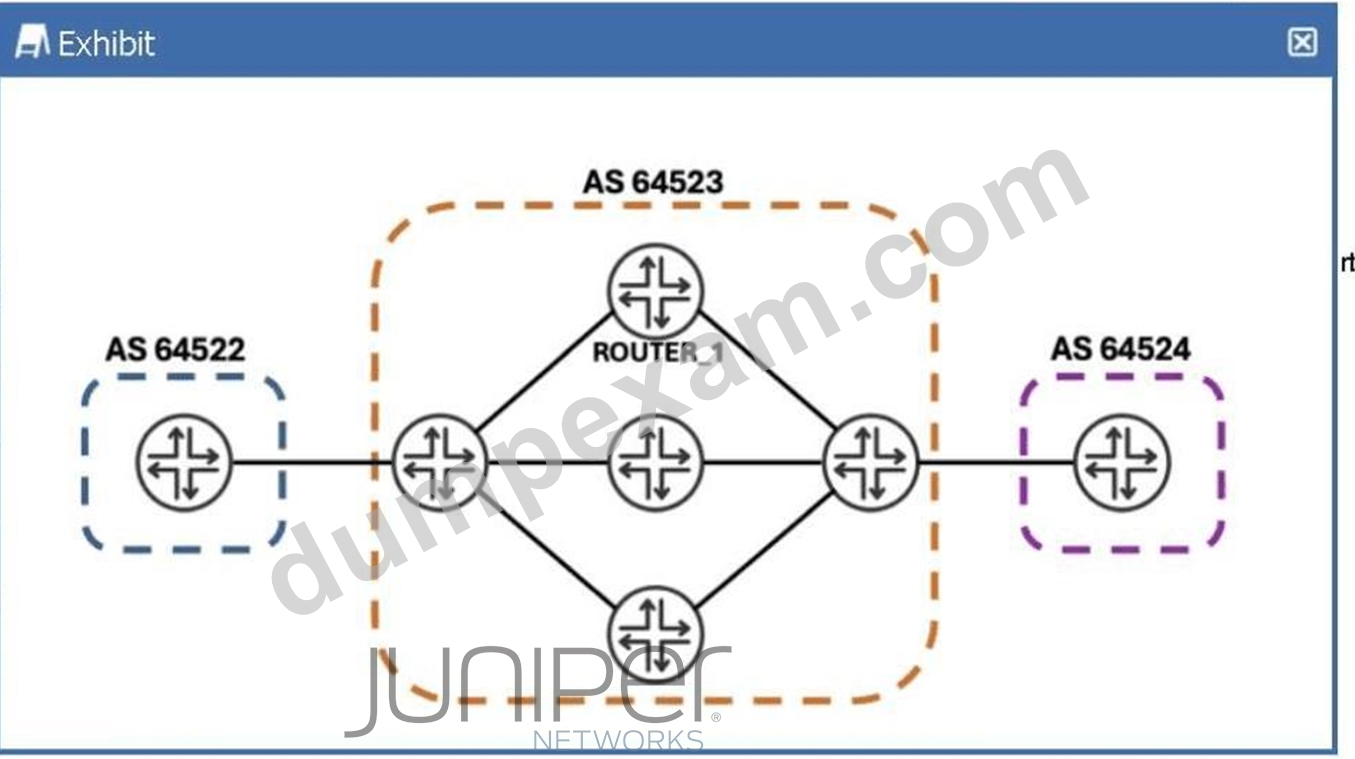
You must configure the router called ROUTER_1 to take all valid prefixes learned from internal BGP peers in AS 64523, and then re-advertise them to other internal BGP peers in the same autonomous system.
Referring to the exhibit, which configuration must you deploy on ROUTER_1 to accomplish this task?
- A. Configure ROUTER_1's internal BGP group with a routing policy that exports prefixes learned from internal BGP.
- B. Configure ROUTER_1's internal BGP group with the keyword cluster, followed by a unique 32-bit number.
- C. Configure ROUTER_1 to belong to a different autonomous system than the other BGP routers in your network.
- D. Configure a routing policy on ROUTER_1 that removes the no-export BGP community from all received prefixes.
Answer: B
Explanation:
In theBorder Gateway Protocol (BGP), theSplit Horizonrule is a fundamental loop-prevention mechanism for internal sessions. This rule dictates that a BGP speaker must not advertise a route learned from anInternal BGP (IBGP)peer to any other IBGP peer within the same Autonomous System (AS). This ensures that routes do not circulate infinitely inside a network, as IBGP does not modify the AS_PATH attribute. Consequently, to maintain full reachability, a network normally requires a "full mesh" of IBGP sessions, where every BGP- speaking router is directly peered with every other router.
In the provided exhibit,ROUTER_1is part of AS 64523. The requirement is for ROUTER_1 to take prefixes learned from its internal peers and re-advertise them to other internal peers in the same AS. This behavior is a direct violation of the standard Split Horizon rule. According to Juniper Networks technical documentation, the standard solution to scale IBGP without a full mesh is to configureRoute Reflection.
When a router is configured as aRoute Reflector (RR), it is permitted to "reflect" (re-advertise) routes learned from one IBGP peer to another. In Junos OS, the mechanism to enable Route Reflection is to configure acluster IDwithin the BGP group. By adding the cluster keyword followed by a unique 32-bit identifier (usually the router's loopback address) to the internal BGP group configuration, the router assumes the role of an RR. It then follows specific reflection rules:
* Routes learned from anEBGP peerare reflected to all IBGP peers.
* Routes learned from aRoute Reflector Clientare reflected to all other clients and non-clients.
* Routes learned from anon-clientare reflected to all clients.
Option A is incorrect because BGP advertisement rules are hard-coded; a standard export policy cannot override the Split Horizon rule. Option C handles traffic engineering tags but does not enable route reflection.
Option D would change the session to EBGP, which does not address the internal reachability requirement within AS 64523. Therefore, configuring the cluster ID is the only valid way to achieve the desired re- advertisement behavior.
NEW QUESTION # 43
The MPLS Label Information Base (LIB) is stored in which table?
- A. mpls.0
- B. inet.3
- C. inet.0
- D. inet6.0
Answer: A
Explanation:
In Junos OS, the Routing Engine maintains several different tables to manage various types of reachability and forwarding information. When a router is running MPLS, it must track both IP routes and label-to-label mappings.
Thempls.0table is the primary repository for theLabel Information Base (LIB)and theLabel Forwarding Information Base (LFIB). According to Juniper Networks documentation, mpls.0 is used by transit and egress routers to perform label lookups. When a labeled packet arrives at an interface, the router looks at the top label and references the mpls.0 table to determine the next action. This table stores the mapping of incoming labels to their corresponding operations:Pop(remove the label),Swap(replace the label), orPush(add an additional label).
It is crucial to understand the roles of the other tables to avoid confusion:
* inet.0 (Option D):This is the default unicast routing table for IPv4, used for standard IP-to-IP forwarding.
* inet.3 (Option C):This is theMPLS Path Table. It stores the egress loopback addresses of LSPs and is used by BGP for next-hop resolution to determine if a destination can be reached via an MPLS tunnel.
While inet.3 knowsaboutLSPs, the actual label-switching instructions reside in mpls.0.
* inet6.0 (Option A):This is the default unicast routing table for IPv6.
Therefore, for the specific purpose of storing the label base used for transit switching operations,mpls.0is the correct and only table used in the Junos architecture.
NEW QUESTION # 44
What is the default route preference for an aggregate route?
- A. 0
- B. 1
- C. 2
- D. 3
Answer: B
Explanation:
In the Junos OS architecture,route preference(often referred to as administrative distance in other vendor platforms) is the primary metric used by the Routing Engine to select the "best" path when multiple protocols provide a route to the same destination. Each routing protocol and route type is assigned a default numeric value; the lower the value, the more preferred the route.
According to Juniper Networks technical documentation, anaggregate routeis assigned a default preference of
130. Aggregate routes are a form of static-like route used to group specific routes into a single, broader prefix to reduce the size of routing tables and limit the scope of routing updates. They are "protocol-independent" because they are not learned from a dynamic neighbor but are manually defined by the administrator.
To understand where130fits in the hierarchy, it is helpful to compare it with other common Junos preferences:
* Directly connected interfaces:0
* Static routes:5
* OSPF Internal:10
* IS-IS Level 1/2:15/18
* Aggregate routes: 130
* OSPF AS External:150
* BGP (Internal and External):170
* Generated routes:150
By setting the aggregate route preference to 130, Junos ensures that specific routes learned via IGPs (like OSPF or IS-IS) are preferred over the aggregate. This is essential because an aggregate route is often used as a
"catch-all" or a discard route when more specific path information is missing. If the aggregate had a lower preference (like 5), it might override dynamic routing information, leading to suboptimal routing or black- holed traffic.
NEW QUESTION # 45
Which statement about RSVP-signaled LSPs is correct?
- A. The paths used by LSPs are always calculated using the TED.
- B. CSPF is not required for LSPs using admin-groups.
- C. CSPF is used to calculate the path for a traffic-engineered LSP.
- D. The paths used by LSPs are always calculated using the SRGB.
Answer: C
Explanation:
In a Juniper Networks environment,Resource Reservation Protocol (RSVP)is a signaling protocol used to establish Label-Switched Paths (LSPs). While RSVP handles the actual signaling (requesting labels and reserving bandwidth along a path), it does not inherently know which path to take. This is whereConstrained Shortest Path First (CSPF)comes into play.
CSPFis an advanced version of the Dijkstra algorithm used specifically for traffic engineering. Unlike the standard SPF used by IGPs, which only considers the shortest metric, CSPF takes into account multiple constraints such as available bandwidth, link coloring (administrative groups), and explicit hop requirements.
According to Juniper technical documentation, when an LSP is configured, the Ingress router uses CSPF to calculate a loop-free path that satisfies all these constraints before RSVP begins signaling. This is why statementBis the correct description of the operational flow.
StatementDis a common distractor. While CSPF uses theTraffic Engineering Database (TED)to perform its calculations, the path is not "calculated by the TED" itself; the TED is merely the repository of link-state information (provided by OSPF or IS-IS extensions). StatementCrefers to Segment Routing Global Block (SRGB), which is relevant to Segment Routing (SR-TE), not standard RSVP-signaled LSPs. Finally, statement Ais incorrect because admin-groups (link coloring) are actually one of the primary constraints thatrequire CSPF to determine a valid path.
NEW QUESTION # 46
A BGP router receives two routes to the same prefix. One route has a higher local preference, while the other has a shorter AS path. In this scenario, which route would be selected?
- A. The route with the higher local preference.
- B. The route with the lowest MED value.
- C. The route with the shorter AS path.
- D. The route with the lower origin code.
Answer: A
Explanation:
TheBGP path selection algorithmis a deterministic process used by Juniper routers to select the single "best" path from the BGP table to be placed into the routing table (inet.0). This algorithm follows a specific, hierarchical set of rules. According to Juniper Networks technical documentation, the router evaluates attributes in a fixed order, and once a tie is broken at a specific step, the remaining steps are ignored.
The order of the primary BGP attributes in Junos OS is as follows:
* Highest Local Preference:This is the first attribute evaluated after the basic check for a reachable next hop. Local preference is used within an Autonomous System (AS) to prioritize one exit point over another.
* Shortest AS_PATH:If the local preference is equal, the router then evaluates the length of the AS_PATH attribute.
* Lowest Origin Code:(IGP < EGP < Incomplete).
* Lowest Multi-Exit Discriminator (MED).
In this specific scenario, the router compares a path with ahigher local preferenceagainst a path with a shorter AS path. Because theLocal Preferencecheck occurs at Step 1 and theAS_PATHcheck occurs later at Step 2, the router will select the path with the higher local preference immediately. The length of the AS path becomes irrelevant in this comparison because the tie was already broken by the local preference value.
This allows network administrators to override the default "shortest path" logic of BGP to prefer specific providers or links based on business requirements.
NEW QUESTION # 47
Exhibit: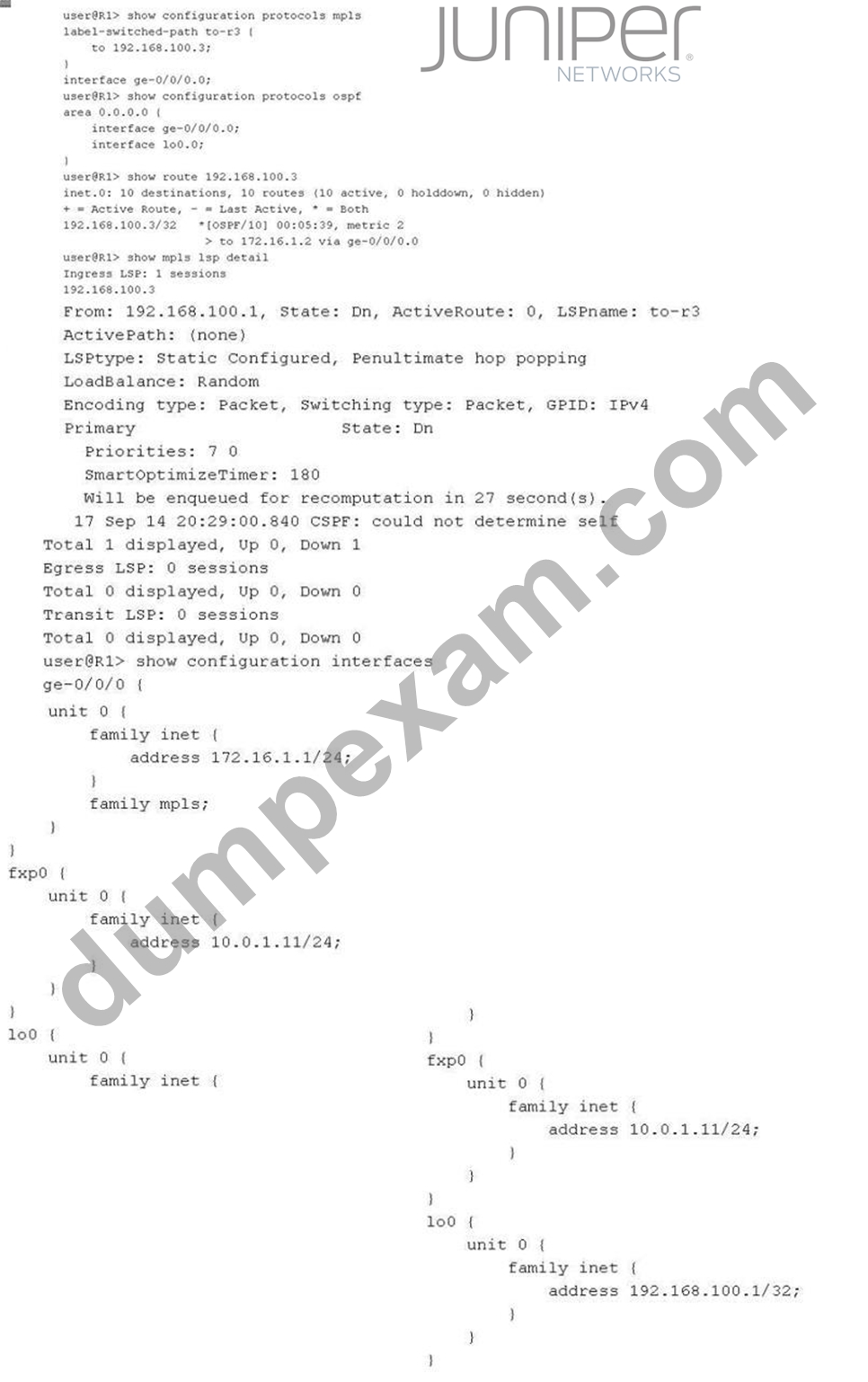
You have configured an MPLS LSP to 192.168.100.3. However, the LSP is in the down state. Referring to the exhibit, which two actions would solve this problem? (Choose two.)
- A. Issue the set routing-options rib inet.3 static route 192.168.100.1 command and commit.
- B. Issue the set protocols ospf traffic-engineering command and commit.
- C. Issue the set interfaces lo0 family mpls command on router R1 and commit.
- D. Issue the set protocols mpls label-switched-path to-r3 no-cspf command and commit.
Answer: B,D
Explanation:
In a Juniper Networks environment, establishing a functionalMultiprotocol Label Switching (MPLS)Label- Switched Path (LSP) requires synchronized control plane operations. According to Juniper technical documentation, the most common reason for an LSP to remain in the "Down" state at the ingress router is a failure of theConstrained Shortest Path First (CSPF)algorithm during the path computation phase.
The provided exhibit for routerR1reveals a critical error in the show mpls lsp detail output: "CSPF: could not determine self". This specific error indicates that the CSPF process is unable to find its own local router ID within theTraffic Engineering Database (TED). For CSPF to build a valid TED, the underlying Interior Gateway Protocol (IGP), such as OSPF, must be configured to flood opaque link-state advertisements (Type
10 LSAs) that carry traffic engineering attributes. As seen in the OSPF configuration, traffic engineering is not enabled. Therefore, issuing theset protocols ospf traffic-engineeringcommand (Option D) will allow R1 to populate the TED with its own local information and that of its neighbors, enabling CSPF to calculate a valid path.
Alternatively, an administrator can choose to bypass the requirement for a TED entirely by disabling CSPF on the specific LSP. By issuing theset protocols mpls label-switched-path to-r3 no-cspfcommand (Option B), the router will stop attempting to perform a constrained path calculation. Instead, the signaling protocol (RSVP) will rely on the standardinet.0routing table to determine the hop-by-hop path to the egress destination (192.168.100.3), allowing the LSP to establish without traffic engineering constraints.
Regarding the other options, whilefamily mplsis required on all transit interfaces, the ingress loopback interface (lo0) generally does not require it for standard LSP signaling unless it's used as a transit hop.
Furthermore, adding a static route toinet.3(Option A) is used for next-hop resolution of BGP routes over LSPs but does not assist in the signaling or establishment of the LSP itself.
NEW QUESTION # 48
You are configuring BGP for IPv6 operations. In this scenario, which two statements are correct? (Choose two.)
- A. The router ID uses a 128-bit identifier value.
- B. The Autonomous System Number (ASN) must be a 64-bit value.
- C. The Autonomous System Number (ASN) can be either a 32-bit or 64-bit value.
- D. The router ID uses a 32-bit identifier value.
Answer: C,D
Explanation:
When implementingMultiprotocol BGP (MP-BGP)for IPv6, several architectural constants remain consistent with the original BGP design, while others have evolved to accommodate larger network scales.
Router ID (Option C):
A critical point in Juniper's Service Provider documentation is that theBGP Router IDremains a32-bit value, even when the protocol is carrying 128-bit IPv6 prefixes. The Router ID is typically represented in dotted- quad notation (e.g., 192.168.1.1). In an IPv6-only environment, a Juniper router cannot automatically derive this ID from an interface address, so it must be manually defined under [edit routing-options]. This 32-bit ID is essential for BGP tie-breaking and loop prevention within the AS.
Autonomous System Number (Option D):
TheAutonomous System Number (ASN)was originally a 16-bit value (0 to 65535). However, to address the exhaustion of available ASNs, the standard was extended to32-bit ASNs(documented in RFC 6793). In Junos OS, you can configure BGP using either the older 16-bit format or the newer 32-bit format (often represented in "asplain" or "asdot" notation). While the question mentions a 64-bit value, there is currently no standard for a 64-bit ASN in BGP; the transition from 16-bit to 32-bit satisfies current global scalability needs. Therefore, Option D is the most accurate within the context of current networking standards, as it acknowledges the coexistence of different ASN lengths.
NEW QUESTION # 49
Which BGP attribute is optional, transitive, and is passed unchanged to other BGP peers if not recognized?
- A. Origin
- B. AS Path
- C. MED
- D. Community
Answer: D
Explanation:
BGP attributes are categorized into four distinct types based on how they are handled by a BGP speaker:Well- known mandatory,Well-known discretionary,Optional transitive, andOptional non-transitive.
Understanding these categories is essential for traffic engineering and ensuring consistent policy across an Autonomous System.
According to Juniper Networks technical documentation, theCommunityattribute is classified as anoptional transitiveattribute. The term "optional" implies that a BGP implementation is not required to support or recognize the attribute. However, because it is "transitive," if a Juniper router receives an update containing a community tag that it does not recognize or has no specific policy for, it must accept the attribute and pass it along to other BGP peers unchanged. This ensures that community-based policies can be signaled across intermediate ASes that may not be configured to act upon those specific tags.
In contrast:
* Origin (Option A)andAS Path (Option B)arewell-known mandatoryattributes. Every BGP update must include these, and every BGP-compliant router must recognize them.
* MED (Option D)(Multi-Exit Discriminator) is anoptional non-transitiveattribute. If a router receives a MED and advertises that route to an EBGP peer, the MED is typically stripped away (unless specific configurations like path-selection cisco-non-deterministic are used), as it is intended only to influence the immediate neighboring AS.
The Community attribute (defined in RFC 1997) is a powerful tool in Junos OS, often used for tagging routes to trigger specific routing policies, such as setting local preference or identifying the geographic origin of a prefix. By being transitive, it allows for sophisticated administrative control across complex multi-provider environments.
NEW QUESTION # 50
......
Use Valid New JN0-364 Test Notes & JN0-364 Valid Exam Guide: https://www.dumpexam.com/JN0-364-valid-torrent.html
JN0-364 exam torrent Juniper study guide: https://drive.google.com/open?id=1RlKjeVpnMszKETQvXTnOpFGld2kGzYRd
