

[Aug-2024] Adobe AD0-E134 Test Engine PDF - All Free Dumps from DumpExam
Get New AD0-E134 Certification – Valid Exam Dumps Questions
NEW QUESTION # 18
A developer needs to create a project based on AEM Project Archetype with a specific AEM as a Cloud Service SDK version on the local environment.
Which two properties must be defined when creating this project? (Choose two.)
- A. aemVersion=latest
- B. aemVersion=cloud
- C. aemVersion=2022.5.7575.20220530T152407Z-220401
- D. sdkVersion=latest
- E. sdkVersion=2022.5.7575.20220530T152407Z-220401
Answer: B,E
Explanation:
Explanation
The aemVersion property specifies the target AEM version for the project. To create a project based on AEM as a Cloud Service SDK, the value should be set to cloud. The sdkVersion property specifies the AEM as a Cloud Service SDK version to use for local development. To use a specific SDK version, the value should be set to the exact version number, such as 2022.5.7575.20220530T152407Z-220401. References:
https://experienceleague.adobe.com/docs/experience-manager-core-components/using/developing/archetype/usin
NEW QUESTION # 19
An AEM server is overloaded with too many concurrently running workflows. The developer decides to reduce the number of concurrent workflows.
What should be configured to reduce the number of concurrent workflows?
- A. Maximum Parallel Jobs in OSGI console
- B. The number of threads in Scheduler
- C. Launchers for each workflow
- D. The number of threads in Apache Felix Jetty Http Service
Answer: A
Explanation:
Explanation
Maximum Parallel Jobs is a configuration property that controls how many workflows can run concurrently on an AEM instance. Reducing this value can help to avoid overloading the server with too many workflows.
NEW QUESTION # 20
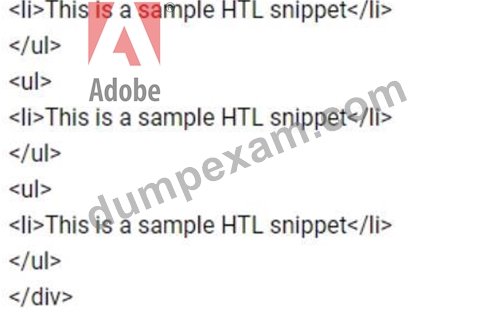
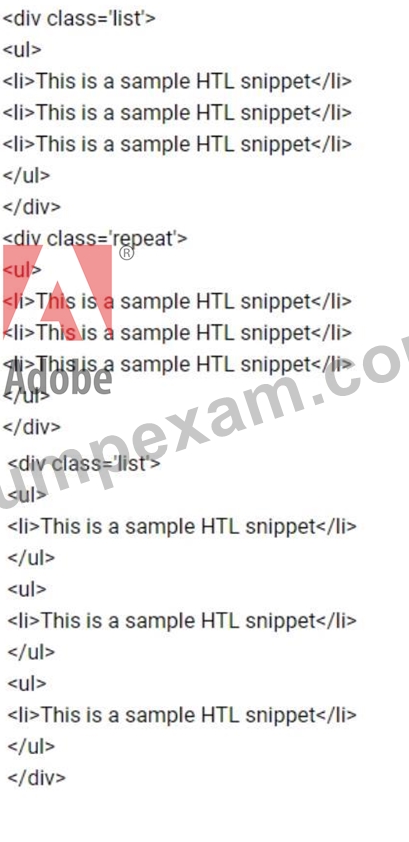
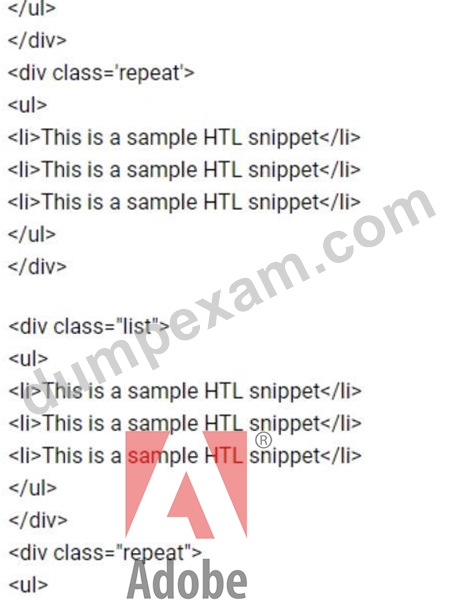
Refer to the exhibit.
The current page has three children.
What is the final rendered html output for the code snippet?
- A.
- B.
- C.
Answer: C
Explanation:
Explanation
Option B is the final rendered html output for the code snippet. The code snippet uses the data-sly-list block statement to iterate over the child pages of the current page. The data-sly-list statement assigns each child page to a variable named page and provides an index variable named i. The code snippet then uses the data-sly-test block statement to check if the index is odd or even and applies a different CSS class accordingly. The code snippet also uses the data-sly-element block statement to create an HTML element with the name specified by the elementName variable. The code snippet also uses the data-sly-attribute block statement to add an attribute with the name specified by the attrName variable and the value specified by the attrValue variable. The code snippet also uses the data-sly-resource block statement to include a resource with the path specified by the page.path variable and the resourceType specified by the resourceType variable.
References:https://experienceleague.adobe.com/docs/experience-manager-htl/using-htl/htl-block-statements.htm
NEW QUESTION # 21
What two types of testing are available OOB in AEM Cloud Manager Pipeline? (Select Two.)
- A. Ul testing
- B. Code Quality testing
- C. Integration testing
- D. Penetration testing
- E. Performance testing
Answer: A,B
Explanation:
Explanation
Code Quality testing and UI testing are two types of testing that are available OOB in AEM Cloud Manager Pipeline. Code Quality testing checks the code quality of the project using SonarQubeand reports any issues or vulnerabilities. UI testing checks the functionality and usability of the project using Selenium WebDriver and reports any errors or failures. References:
https://experienceleague.adobe.com/docs/experience-manager-cloud-service/implementing/testing/testing-overvi
https://experienceleague.adobe.com/docs/experience-manager-cloud-service/implementing/testing/code-quality-t
NEW QUESTION # 22
A developer needs to create a workflow custom process step in AEM. In a custom process step, an OSGi component needs to implement the WorkflowProcess interface.
Which method should the developer implement?
- A. apply
- B. execute
- C. submit
- D. call
Answer: B
Explanation:
Explanation
The WorkflowProcess interface is the interface to be used for automatic workflow steps implemented in Java.
Classes implementing this interface define Java based processes that can be attached to a WorkflowNode and executed by the workflow engine. The method execute takes a WorkItem, a WorkflowSession and a MetaDataMap as parameters and performs the logic of the custom process step. References:
https://developer.adobe.com/experience-manager/reference-materials/6-5/javadoc/com/adobe/granite/workflow/e
NEW QUESTION # 23
An application development team needs to create a multi-channel application that uses AEM as a headless CMS Which feature should be used to maintain structured data for this application?
- A. Custom component
- B. Content fragment
- C. Static template
- D. Experience fragment
Answer: B
Explanation:
Explanation
A content fragment is a reusable piece of content that can be authored and managed independently from a page. Content fragments are based on structured data models that define the elements and data types of the content. Content fragments can be delivered as JSON using various APIs, such as Assets HTTP API, Content Fragments REST API, or Content Fragments GraphQL API. Content fragments are suitable for creating multi-channel applications that use AEM as a headless CMS. References:
https://experienceleague.adobe.com/docs/experience-manager-learn/foundation/headless/introduction-to-headles
NEW QUESTION # 24
The OSGi configuration is added to a runmode specific configuration "config.author.staging" in AEM as a Cloud Service. The application fails to read the configuration.
What is a possible cause of this issue?
- A. OSGi configuration runmodes cannot be installed automatically on AEM as a Cloud Service. We need to install them as a package using the Package manager.
- B. Only <service> specific OSGi configuration runmodes like "config.author" or "config.publish" are supported in AEM as a Cloud service.
- C. AEM as a Cloud service does not support OSGi configuration runmodes.
- D. The custom OSGi configuration runmode used (i.e., "config.author.staging") is not supported in AEM as a Cloud service.
Answer: B
Explanation:
Explanation
AEM as a Cloud Service does not support custom OSGi configuration runmodes, such as
"config.author.staging". Only <service> specific OSGi configuration runmodes, such as "config.author" or
"config.publish", are supported. These runmodes are used to apply configurations to specific services, such as author or publish. The <service> specific runmodes can be combined with environment variables to achieve different configurations for different environments. References:
https://experienceleague.adobe.com/docs/experience-manager-cloud-service/implementing/deploying/configurin
NEW QUESTION # 25
The following anchor tag is not resolving:
<a href="item.path" >{item.name}</a>
Upon further inspection the developer notices that the link has no .html appended to the end of the URL What could be a potential fix for the issue?
- A.

- B.

- C.

- D.

Answer: D
Explanation:
Explanation
Option B is a potential fix for the issue. Option B uses the data-sly-attribute block statement to add the href attribute to the anchor tag. The data-sly-attribute statement uses an expression to append ".html" to the item.path value. This way, the link will have the correct extension and will resolve to the corresponding page.
References:https://experienceleague.adobe.com/docs/experience-manager-htl/using-htl/htl-block-statements.htm
NEW QUESTION # 26
In a non-optimized website, the final HTML generated for a typical page by publish instance includes a relatively large number of <script> elements that refer to other script files loaded from AEM environment. The developer wants to minimize these network calls by combining all required client library code into a single file to reduce the number of back-and-forth requests on page load.
Which step should a developer take to solve this issue?
- A. Add the categories property of the cq:Clientl_ibraryFolder node into an app-specific client library folder
- B. Embed the required libraries into an app-specific client library using the embed property of the cq:ClientLibraryFolder node
- C. Embed the required libraries into an app-specific client library using the allowProxy property of the cq:Clientl_ibraryFolder node
- D. Embed the required libraries into an app-specific client library using the dependencies property of the cq:Clientl_ibraryFolder node
Answer: D
Explanation:
Explanation
The embed property of the cq:ClientLibraryFolder node allows embedding code from a client library into another client library. At runtime, the generated JS and CSS files of the embedding library include the code of the embedded library. This reduces the number of network calls and improves performance. Embedding code is useful for providing access to libraries that arestored in secured areas of the repository. References:
https://experienceleague.adobe.com/docs/experience-manager-cloud-service/content/implementing/developing/fu
NEW QUESTION # 27
A developer needs to create a new Title component. The requirements are:
1. The layout must be the same as the Title core component
2. The text property must have the page title as prefix (e.g., Page Title - <component text>)
3. The component must be reusable
Which approach is recommended?
- A. 1. Create a Proxy Component of Title core component
2. Create a Custom Sling Model that overrides the default behavior
3. Customize the component template
B, 1. Create a custom component from scratch
2. Create a Custom Sling Model for the component that follows the requirement
3. Create a Model Exporter - B. 1. Create a Proxy Component from Title core component
2. Create a Custom Sling Model that overrides the default behavior
Answer: A
Explanation:
Explanation
A proxy component is a site-specific component that inherits from a core component and allows customization of the component name, group, dialog, and behavior. A proxy component can refer to any version of the core component by changing the sling:resourceSuperType property. A custom sling model can be used to implement the logic for adding the page title as prefix to the text property. A component template can be used to define the layout of the component.
NEW QUESTION # 28
AEM SPA integration provides various design models. In an application the developer chooses to use AEM as a headless CMS without using the SPA Editor SDK framework.
What would be an advantage for this design model?
- A. The SPA is compatible with the template editor
- B. The developer keeps control over the app by only enabling authoring in restricted areas of the app
- C. The content author can edit the app using AEM's content authoring experience.
- D. The developer has full control over the app.
Answer: D
Explanation:
Explanation
AEM SPA integration provides various design models for different levels of authoring capabilities and developer control. In the design model where AEM is used as a headless CMS without using the SPA Editor SDK framework, the developer has full control over the app and can use any SPA framework or library.
However, this also means that the content author cannot edit the app using AEM's content authoring experience, the SPA is not compatible with the template editor, and the developer cannot enable authoring in restricted areas of the app.
References:https://experienceleague.adobe.com/docs/experience-manager-learn/spa-editor-overview/spa-overvie
NEW QUESTION # 29
Which configuration/section should be used to resolve the domain name by dispatcher?
- A. Configuration in DNS
- B. Configuration in httpd.conf
- C. Configuration in vhosts file
- D. Configuration in filters.any
Answer: A
Explanation:
Explanation
The configuration in DNS (Domain Name System) should be used to resolve the domain name by dispatcher.
The DNS resolves the domain names to the IP address of the web server that hosts the dispatcher. The dispatcher then matches the incoming request URL with the cached files or the AEM publish instances.
References:https://experienceleague.adobe.com/docs/experience-manager-dispatcher/using/configuring/dispatche
NEW QUESTION # 30
Which tool should a developer use to look up Adobe Identity Management System (IMS) users by email and return their IMS IDs?
- A. IMS Lookup Tool
- B. Developer Console
- C. User Mapping Tool
- D. Cloud Acceleration
Answer: A
Explanation:
Explanation
The IMS Lookup Tool is a tool that allows looking up Adobe Identity Management System (IMS) users by email and returning their IMS IDs. The IMS Lookup Tool is available in the Cloud Manager UI under the Tools menu. The IMS Lookup Tool can be used to find the IMS IDs of users who need to be added to Cloud Manager programs or environments. References:
https://experienceleague.adobe.com/docs/experience-manager-cloud-service/implementing/using-cloud-manager
NEW QUESTION # 31
A customer who is running an AEM application on premise reports that the application is slowing down over time and even crashes The issues seem to start occurring after a new production deployment. The AEM developer knows that the described symptoms could be caused by a memory leak.
Which two steps should be taken after confirming the problem is related to a memory issue? (Choose two.)
- A. Increase the cache ratio of the application
- B. Open the error log and look for messages with 'OutOfMemoryError'
- C. Analyze the request log and make sure the number of requests are below the expected threshold
- D. Create a thread dump for analysis
- E. Create a heap dump for analysis
Answer: D,E
Explanation:
Explanation
Creating a heap dump and a thread dump are two steps that should be taken after confirming the problem is related to a memory issue. A heap dump is a snapshot of the memory usage of the Java Virtual Machine (JVM) at a given point in time. A heap dump can be used to identify memory leaks, memory consumption patterns, and objects that occupy large amounts of memory. A thread dump is a snapshot of the state of all threads that are part of the JVM process. A thread dump can be used to identify deadlocks, blocked threads, and CPU-intensive threads. References:
https://experienceleague.adobe.com/docs/experience-manager-65/deploying/configuring/memory-analysis.html?
NEW QUESTION # 32
Which configuration must be applied to enable re-fetching of cached items based on Cache Headers sent by AEM?
- A. /enableTTL "1"
- B. /autolnvalidate true
- C. /autolnvalidate "1"
- D. /enableTTLtrue
Answer: A
Explanation:
Explanation
The /enableTTL "1" configuration must be applied to enable re-fetching of cached items based on Cache Headers sent by AEM. This configuration enables the Time To Live (TTL) feature of dispatcher, which allows dispatcher to check the Cache-Control and Expires headers of the cached files and re-fetch them from AEM if they are expired.
References:https://experienceleague.adobe.com/docs/experience-manager-dispatcher/using/configuring/page-inv
NEW QUESTION # 33
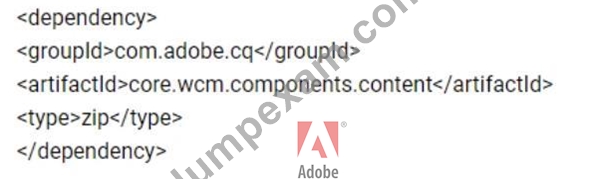
Which AEM dependency provides APIs for all AEM environments?
- A.

- B.

- C.

- D.
Answer: C
Explanation:
Explanation
Option C is the AEM dependency that provides APIs for all AEM environments. Option C uses the uber-jar dependency with the provided scope and the classifier set to apis. The uber-jar dependency contains all the public Java APIs that are available in AEM. The provided scope indicates that the dependency is not required for runtime, as it is already provided by the AEM platform. The apis classifier indicates that only the API classes are included in the dependency, not the implementation classes. References:
https://experienceleague.adobe.com/docs/experience-manager-cloud-service/implementing/developing/aem-proje
NEW QUESTION # 34
A developer needs to create a dynamic participant step where the participant is selected automatically at run time.
The developer decides to develop an OSGi service, which needs to implement the com.day.cq.workflow.exec.ParticipantStepChooser interface.
Which method should the developer implement from the com.day.cq.workflow.exec.ParticipantStepChooser interface?
- A. String getParticipant(Workltem workltem, WorkflowSession workflowSession, MetaDataMap metaDataMap)
- B. String getDynamicParticipant(Workltem workltem, WorkflowSession workflowSession, MetaDataMap metaDataMap)
- C. void getDynamicParticipant(Workltem workltem, WorkflowSession workflowSession, MetaDataMap metaDataMap)
- D. void getParticipant(Workltem workltem, WorkflowSession workflowSession, MetaDataMap metaDataMap)
Answer: B
Explanation:
Explanation
The com.day.cq.workflow.exec.ParticipantStepChooser interface is intended for implementations that will define the participant dynamically. This interface replaces the deprecated com.day.cq.workflow.exec.ParticipantChooser interface. The method getDynamicParticipant returns the dynamically resolved Principal id based on the work item, workflow session and metadata map parameters.
References:https://developer.adobe.com/experience-manager/reference-materials/cloud-service/javadoc/com/day
NEW QUESTION # 35
What is Out of Scope for the Pattern Detector tool, while doing an AEM upgrade?
- A. rep:User nodes compatibility (in context of OAuth configuration)
- B. OSGi bundles exports and imports mismatch
- C. Backward Compatibility with the previous AEM Version
- D. Definitions of Oak indices for compatibility
Answer: C
Explanation:
Explanation
Backward Compatibility with the previous AEM Version is out of scope for the Pattern Detector tool, while doing an AEM upgrade. The Pattern Detector tool is a tool that scans an existing AEM code base and identifies patterns that are incompatible with AEM as a Cloud Service or newer versions of AEM on-premise.
The tool does not check for backward compatibility with older versions of AEM, as this is not a requirement for upgrading. References:
https://experienceleague.adobe.com/docs/experience-manager-cloud-service/moving/cloud-migration/pattern-det
NEW QUESTION # 36
Which environment-specific configuration is used in AEM as a Cloud Service to store private API keys?
- A. $[secret:ENV_VAR_NAME]
- B. $[secret:SECRET_VAR_NAME]
- C. $[env:SECRET_VAR_NAME]
- D. $[env:ENV_VAR_NAME]
Answer: B
Explanation:
Explanation
This syntax allows the developer to reference a secret variable that is stored in the Cloud Manager UI under Environment Details > Variables. The secret variable name must start with a lowercase letter and can contain alphanumeric characters and underscores. References:
https://experienceleague.adobe.com/docs/experience-manager-cloud-service/implementing/deploying/configurin
NEW QUESTION # 37
An AEM application wants to set up multi-tenancy using Adobe-recommended best practices and bind multiple configurations to it. Which of the following options is recommended?
- A. import org.osgi.service.metatype.annotations.AttributeDefinition;
import org.osgi.service.metatype.annotations.ObjectClassDefinition;
@ObjectClassDefinition(name = "My configuration") - B. import org.apache.felix.scr.annotations.Component; @Component(label = "My configuration", metatype = true, factory= true)
- C. @Component(service = ConfigurationFactory.class)
@Designate(ocd = ConfigurationFactorylmpl.Config.class, factory=true) - D. import org.osgi.service.component.annotations.Component; @Component(service = ConfigurationFactory.class)
Answer: C
Explanation:
Explanation
The @Component(service = ConfigurationFactory.class) @Designate(ocd =
ConfigurationFactorylmpl.Config.class,factory=true) option is recommended for creating a multi-tenancy configuration and binding multiple configurations to it. This option uses the OSGi R6 annotations to define a component that provides a service of type ConfigurationFactory and designates a class that contains the configuration properties. The factory=true attribute indicates that multiple configurations can be created for this component.
References:https://experienceleague.adobe.com/docs/experience-manager-65/deploying/configuring/osgi-configu
NEW QUESTION # 38
Which type of Cloud Manager tests are enabled for all Cloud Manager production pipelines and cannot be skipped?
- A. Code Quality Testing
- B. Ul Testing
- C. Functional Testing
- D. Experience Audit Testing
Answer: A
Explanation:
Explanation
Code Quality Testing is a type of Cloud Manager tests that are enabled for all Cloud Manager production pipelines and cannot be skipped. Code Quality Testing checks the code quality of the project using SonarQube and reports any issues or vulnerabilities. Code Quality Testing can fail the pipeline if the code quality does not meet the minimum standards defined by Adobe. References:
https://experienceleague.adobe.com/docs/experience-manager-cloud-service/implementing/testing/testing-overvi
NEW QUESTION # 39
......
100% Passing Guarantee - Brilliant AD0-E134 Exam Questions PDF: https://www.dumpexam.com/AD0-E134-valid-torrent.html
AD0-E134 Dumps 2024 - NewAdobe Exam Questions: https://drive.google.com/open?id=1VKNolR3R8pLJDjdjXDxfr378jGJoQIa9
