

[Sep-2021] Pass Cisco 350-401 Exam in First Attempt Guaranteed!
Full 350-401 Practice Test and 260 unique questions with explanations waiting just for you, get it now!
NEW QUESTION 70
In a Cisco SD-Access wireless architecture, which device manages endpoint ID to Edge Node bindings?
- A. fabric wireless controller
- B. fabric control plane node
- C. fabric border node
- D. fabric edge node.
Answer: B
Explanation:
Explanation
SD-Access Wireless Architecture Control Plane Node -A Closer Look
Fabric Control-Plane Node is based on a LISP Map Server / Resolver
Runs the LISP Endpoint ID Database to provide overlay reachability information + A simple Host Database, that tracks Endpoint ID to Edge Node bindings (RLOCs) + Host Database supports multiple types of Endpoint ID (EID), such as IPv4 /32, IPv6 /128* or MAC/48 + Receives prefix registrations from Edge Nodes for wired clients, and from Fabric mode WLCs for wireless clients + Resolves lookup requests from FE to locate Endpoints + Updates Fabric Edge nodes, Border nodes with wireless client mobility and RLOC information Reference: https://www.ciscolive.com/c/dam/r/ciscolive/latam/docs/2018/pdf/BRKEWN-2020.pdf
NEW QUESTION 71
An engineer is configuring a new SSID to present users with a splash page for authentication. Which WLAN Layer 3 setting must be configured to provide this functionally?
- A. CCKM
- B. Web Policy
- C. WPA2 Policy
- D. Local Policy
Answer: D
NEW QUESTION 72
Drag and Drop the decryptions from the left onto the routing protocol they describe on the right.
Answer:
Explanation:
NEW QUESTION 73
Refer to the exhibit.
A port channel is configured between SW2 and SW3. SW2 is not running a Cisco operating system. When all physical connections are mode, the port channel does not establish. Based on the configuration excerpt of SW3, what is the cause of the problem?
- A. The port-channel interface lead balance should be set to src-mac
- B. The port channel on SW2 is using an incompatible protocol.
- C. The port-channel should be set to auto.
- D. The port-channel trunk is not allowing the native VLAN.
Answer: B
NEW QUESTION 74
Refer to the exhibit.
An engineer configures monitoring on SW1 and enters the show command to verify operation. What does the output confirm?
- A. SPAN session 2 only monitors egress traffic exiting port FastEthernet 0/14.
- B. SPAN session 2 monitors all traffic entering and exiting port FastEthernet 0/15.
- C. SPAN session 1 monitors activity on VLAN 50 of a remote switch
- D. RSPAN session 1 is incompletely configured for monitoring
Answer: D
Explanation:
SW1 has been configured with the following commands:
SW1(config)#monitor session 1 source remote vlan 50 SW1(config)#monitor session 2 source interface fa0/14 SW1(config)#monitor session 2 destination interface fa0/15 The session 1 on SW1 was configured for Remote SPAN (RSPAN) while session 2 was configured for local SPAN. For RSPAN we need to configure the destination port to complete the configuration.
Note: In fact we cannot create such a session like session 1 because if we only configure -Source RSPAN VLAN 50 (with the command -monitor session 1 source remote vlan 50) then we will receive a -Type: Remote Source Session (not -Remote Destination Session).
NEW QUESTION 75
Which technology is used to provide Layer 2 and Layer 3 logical networks in the Cisco SD-Access architecture?
- A. underlay network
- B. overlay network
- C. easy virtual network
- D. VPN routing/forwarding
Answer: B
Explanation:
Explanation
NEW QUESTION 76
How does the RIB differ from the FIB?
- A. The RIB is used to create network topologies and routing tables. The FIB is a list of routes to particular network destinations.
- B. The FIB includes many routes a single destination. The RIB is the best route to a single destination.
- C. The RIB includes many routes to the same destination prefix. The FIB contains only the best route
- D. The FIB maintains network topologies and routing tables. The RIB is a Iist of routes to particular network destinations.
Answer: A
Explanation:
Explanation

NEW QUESTION 77
What is the difference between the enable password and the enable secret password when password encryption is enable on an IOS device?
- A. There is no difference and both passwords are encrypted identically.
- B. The enable password is encrypted with a stronger encryption method.
- C. The enable password cannot be decrypted.
- D. The enable secret password is protected via stronger cryptography mechanisms.
Answer: D
Explanation:
The "enable secret" password is always encrypted (independent of the "service password- encryption" command) using MD5 hash algorithm. The "enable password" does not encrypt the password and can be view in clear text in the running-config. In order to encrypt the "enable password", use the "service password-encryption" command. This command will encrypt the passwords by using the Vigenere encryption algorithm. Unfortunately, the Vigenere encryption method is cryptographically weak and trivial to reverse.
The MD5 hash is a stronger algorithm than Vigenere so answer D is correct.
NEW QUESTION 78
What mechanism does PIM use to forward multicast traffic?
- A. PIM sparse mode uses a pull model to deliver multicast traffic.
- B. PIM sparse mode uses a flood and prune model to deliver multicast traffic.
- C. PIM sparse mode uses receivers to register with the RP.
- D. PIM dense mode uses a pull model to deliver multicast traffic.
Answer: A
Explanation:
Explanation
PIM dense mode (PIM-DM) uses a push model to flood multicast traffic to every corner of the network. This push model is a brute-force method of delivering data to the receivers. This method would be efficient in certain deployments in which there are active receivers on every subnet in the network. PIM-DM initially floods multicast traffic throughout the network. Routers that have no downstream neighbors prune the unwanted traffic. This process repeats every 3 minutes.
PIM Sparse Mode (PIM-SM) uses a pull model to deliver multicast traffic. Only network segments with active receivers that have explicitly requested the data receive the traffic. PIM-SM distributes information about active sources by forwarding data packets on the shared tree. Because PIM-SM uses shared trees (at least initially), it requires the use of an RP. The RP must be administratively configured in the network.
Answer C seems to be correct but it is not, PIM spare mode uses sources (not receivers) to register with the RP. Sources register with the RP, and then data is forwarded down the shared tree to the receivers.
Reference: Selecting MPLS VPN Services Book, page 193
NEW QUESTION 79
Which function is handled by vManage in the Cisco SD-WAN fabric?
- A. Establishes IPsec tunnels with nodes.
- B. Distributes policies that govern data forwarding
- C. Establishes BFD sessions to test liveliness of links and nodes
- D. Performs remote software upgrades for WAN Edge. vSmart and vBond
Answer: D
Explanation:
Explanation
We can remote upgrades WAN Edge, vSmart and vBond in vManage.
https://sdwan-docs.cisco.com/Product_Documentation/vManage_Help/Release_18.4/Maintenance/Software_Upg
NEW QUESTION 80
Refer to exhibit.
VLANs 50 and 60 exist on the trunk links between all switches All access ports on SW3 are configured for VLAN 50 and SW1 is the VTP server Which command ensures that SW3 receives frames only from VLAN
50?
- A. SW3(config)#vtp mode transparent
- B. SW1 (config)#vtp mode transparent
- C. SW1 (config)#vtp pruning
- D. SW2(config)#vtp pruning
Answer: C
Explanation:
Explanation
SW3 does not have VLAN 60 so it should not receive traffic for this VLAN (sent from SW2).
Therefore we should configure VTP Pruning on SW3 so that SW2 does not forward VLAN 60 traffic to SW3. Also notice that we need to configure pruning on SW1 (the VTP Server), not SW2.
NEW QUESTION 81
Drag and drop the QoS mechanisms from the left onto their descriptions on the right
Answer:
Explanation:
Explanation
NEW QUESTION 82
Refer to the exhibit.
An engineer must ensure that all traffic leaving AS 200 will choose Link 2 as the exit point. Assuming that all BGP neighbor relationships have been formed and that the attributes have not been changed on any of the routers, which configuration accomplish task?
- A. R3(config-router)neighbor 10.1.1.1 weight 200
- B. R4(config-router)bgp default local-preference 200
- C. R3(config-router)bgp default local-preference 200
- D. R4(config-router)nighbor 10.2.2.2 weight 200
Answer: B
Explanation:
Explanation
Local preference is an indication to the AS about which path has preference to exit the AS in order to reach a certain network. A path with a higher local preference is preferred. The default value for local preference is 100.
Unlike the weight attribute, which is only relevant to the local router, local preference is an attribute that routers exchange in the same AS. The local preference is set with the "bgp default local-preference value" command.
In this case, both R3 & R4 have exit links but R4 has higher local-preference so R4 will be chosen as the preferred exit point from AS 200.
NEW QUESTION 83
Which statements are used for error handling in Python?
- A. catch/release
- B. try/except
- C. try/catch
- D. block/rescue
Answer: B
NEW QUESTION 84 
Refer to the exhibit. An engineer is investigating why guest users are able to access other guest user devices when the users are connected to the customer guest WLAN. What action resolves this issue?
- A. implement P2P blocking
- B. implement Wi-Fi direct policy
- C. implement MFP client protection
- D. implement split tunneling
Answer: B
Explanation:
Explanation
https://www.cisco.com/c/en/us/td/docs/wireless/controller/8-1/configurationguide/b_cg81/b_cg81_chapter_0100
NEW QUESTION 85
Which access point mode allows a supported AP to function like a WLAN client would, associating and identifying client connectivity issues?
- A. SE-connect mode
- B. sensor mode
- C. sniffer mode
- D. client mode
Answer: B
Explanation:
As these wireless networks grow especially in remote facilities where IT professionals may not always be onsite, it becomes even more important to be able to quickly identify and resolve potential connectivity issuesideally before the users complain or notice connectivity degradation. To address these issues we have created Cisco's Wireless Service Assurance and a new AP mode called "sensor"mode. Cisco's Wireless Service Assurance platform has three components, namely, Wireless PerformanceAnalytics, Real-time Client Troubleshooting, and Proactive Health Assessment. Using a supported AP ordedicated sensor the device can actually function much like a WLAN client would associating andidentifying client connectivity issues within the network in real time without requiring an IT or technician to beon site.
NEW QUESTION 86
Refer to the exhibit.
Which type of antenna does the radiation pattern represent?
- A. Yagi
- B. directional patch
- C. omnidirectional
- D. multidirectional
Answer: A
Explanation:
Explanation
A Yagi antenna is formed by driving a simple antenna, typically a dipole or dipolelike antenna, and shaping the beam using a well-chosen series of non-driven elements whose length and spacing are tightly controlled.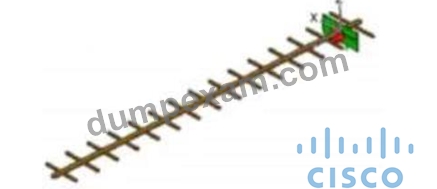
NEW QUESTION 87
Drag and drop the characteristics from the left onto the protocols they apply to on the right?
Answer:
Explanation:
NEW QUESTION 88
Refer to the exhibit.
Assuming the WLC's interfaces are not in the same subnet as the RADIUS server, which interface would the WLC use as the source for all RADIUS-related traffic?
- A. the interface specified on the WLAN configuration
- B. any interface configured on the WLC
- C. the controller management interface
- D. the controller virtual interface
Answer: A
NEW QUESTION 89
Which PAgP mode combination prevents an Etherchannel from forming?
- A. auto/desirable
- B. desirable
- C. auto/auto
- D. desirable/desirable
Answer: C
Explanation:
There are two PAgP modes:
The table below lists if an EtherChannel will be formed or not for PAgP:
NEW QUESTION 90
Refer to the exhibit. R1 is able to ping the R3 fa0/1 interface. Why do the extended pings fail?
- A. R3 is missing a return route to 10.99.69.0/30
- B. The DF bit has been set
- C. R2 and R3 do not have an OSPF adjacency
- D. The maximum packet size accepted by the command is 1476 bytes.
Answer: B
NEW QUESTION 91
Which two operations are valid for RESTCONF? (Choose two.)
- A. PATCH
- B. HEAD
- C. REMOVE
- D. PUSH
- E. ADD
- F. PULL
Answer: A,C
Explanation:
RESTCONF operations include OPTIONS, HEAD, GET, POST, PATCH, DELETE.
NEW QUESTION 92
......
Prepare for your Cisco certification with the updated DumpExam 350-401 exam questions: https://drive.google.com/open?id=1cmdOzX1rmAzv7hTkBmhR60Qj-J87vVq_
Get Latest 350-401 Dumps Exam Questions in here: https://www.dumpexam.com/350-401-valid-torrent.html
