

DumpExam FCSS_ADA_AR-6.7 Exam Questions | Real FCSS_ADA_AR-6.7 Practice Dumps
Verified FCSS_ADA_AR-6.7 Exam Dumps Q&As - Provide FCSS_ADA_AR-6.7 with Correct Answers
NEW QUESTION # 36
Which of the following are two Tactics in the MITRE ATT&CK framework? (Choose two.)
- A. BITS Jobs
- B. Phishing
- C. Rootkit
- D. Reconnaissance
- E. Discovery
Answer: D,E
NEW QUESTION # 37
Why do collectors communicate with the Supervisor after registration? (Choose two.)
- A. To report its own health status
- B. To upload event data if a worker down
- C. To receive templates associated with agents
- D. To report the health status of the agents
Answer: A,B
Explanation:
After registration, collectors maintain continuous communication with the Supervisor to ensure proper event processing, system health monitoring, and failover handling. The two key reasons collectors communicate with the Supervisor are:
1. To upload event data if a worker is down
2. To report its own health status
NEW QUESTION # 38
Refer to the exhibit.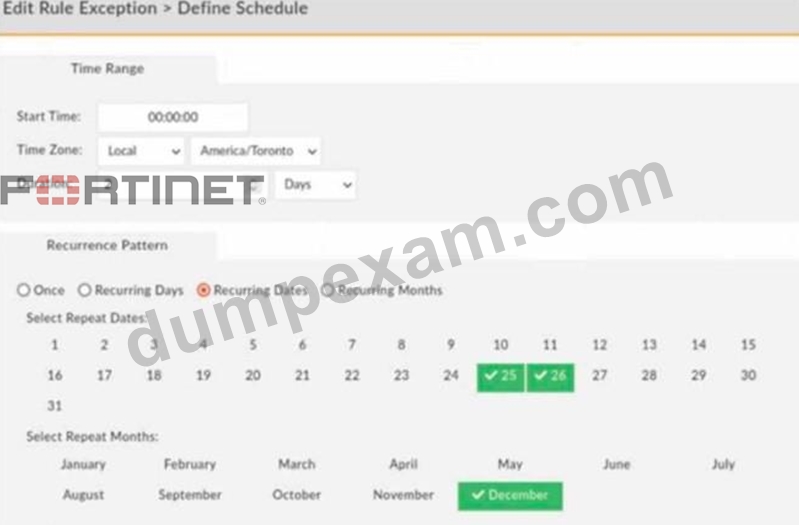
An administrator applies the rule exception shown in the exhibit.
How does this configuration impact the incident generation for that rule?
- A. Incidents will be generated without triggering an email alert during the specified period.
- B. Incidents will not be generated during the specified period.
- C. Incidents will be generated only during the specified period.
- D. Events will not be processed by the rule during the specified period.
Answer: B
Explanation:
From the exhibit, the rule exception is set for:
*Time Range: Starts at 00:00:00
*Duration: 2 days
*Recurrence Pattern: December 25th and December 26th
This means that during these two days (every year in December), the rule will not trigger incidents.
Rule exceptions temporarily suppress incident generation during the specified period.
Events are still processed, but no incidents are generated.
NEW QUESTION # 39
Which statement about EPS bursting is true?
- A. FortiSIEM will let you burst up to five times the licensed EPS once during a 24-hour period.
- B. FortiSIEM must be provisioned with ten percent the licensed EPS to handle potential event surges.
- C. FortiSIEM will let you burst up to five times the licensed EPS at any given time, regardless of unused of EPS.
- D. FortiSIEM will let you burst up to five times the licensed EPS at any given time, provided it has accumulated enough unused EPS.
Answer: D
Explanation:
EPS burstingin FortiSIEM allows temporary spikes in events per second (EPS) beyond the licensed limit, but only if there areaccumulated unused EPS credits. This ensures flexibility in handling short-term surges without requiring a permanent license upgrade.
# FortiSIEMaccumulates unused EPS creditswhen actual EPS usage is below the licensed limit.
# When anevent surgeoccurs, FortiSIEM canburst up to 5x the licensed EPS,but only if there are sufficient accumulated credits.
This allowsadaptive scalingwhile preventing abuse of resources beyond allocated licensing.
NEW QUESTION # 40
During which time period is the license enforcement performed on the number of events received?
- A. Events received every second
- B. Events received every minute
- C. Events received every three minutes
- D. Events received every two minutes
Answer: C
NEW QUESTION # 41
Refer to the exhibit.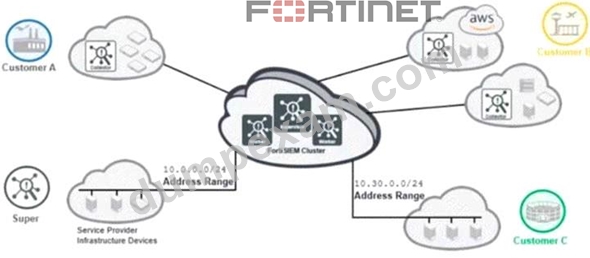
Which deployment type is shown in the exhibit?
- A. Service provider without collectors
- B. Service provider with collectors
- C. Enterprise cloud deployment
- D. Hybrid deployment with and without collectors
Answer: D
Explanation:
The exhibit shows a FortiSIEM cluster deployed in a multi-tenant service provider environment, serving multiple customers. The architecture includes:
1. Customers with Collectors
Customer A and Customer B (AWS) have collectors deployed within their environments.
Collectors gather and forward logs to the FortiSIEM cluster for centralized analysis.
2. Customers Without Collectors
Customer C does not have a collector; instead, it sends logs directly to the FortiSIEM cluster.
3. Super Organization Managing Infrastructure
The service provider infrastructure devices (e.g., networking and security appliances) are managed directly by the FortiSIEM cluster.
This mixed setup, where some customers use collectors while others send logs directly, represents a hybrid deployment with and without collectors.
NEW QUESTION # 42
Refer to the exhibit.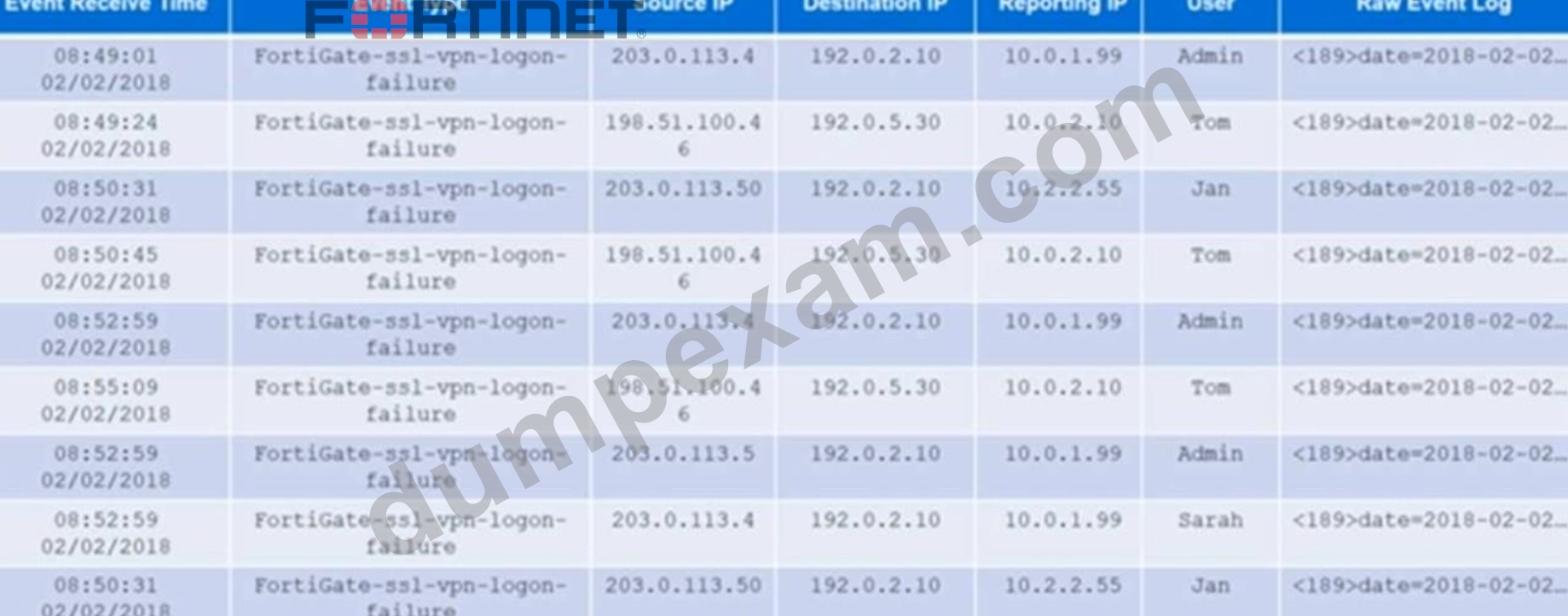
An administrator runs an analytic search for all FortiGate SSL VPN logon failures. The results are grouped by source IP, reporting IP, and user. The administrator wants to restrict the results to only those rows where the COUNT >=3.
Which user would meet that condition?
- A. Sarah
- B. Jan
- C. Tom
- D. Admin
Answer: C
NEW QUESTION # 43
Refer to the exhibit.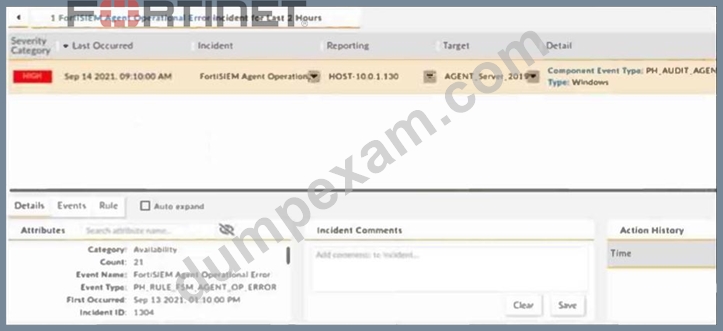
How long has the UEBA agent been operationally down?
- A. 9 Hours
- B. 2 Hours
- C. 21 Hours
- D. 20 Hours
Answer: D
Explanation:
Based on the provided exhibit, we can determine how long the UEBA agent has been operationally down by looking at the "First Occurred" and "Last Occurred" timestamps.
*First Occurred: Sep 13, 2021, at 01:10 PM
*Last Occurred: Sep 14, 2021, at 09:10 AM
From Sep 13, 01:10 PM to Sep 14, 01:10 AM → 12 hours
From Sep 14, 01:10 AM to Sep 14, 09:10 AM → 8 hours
Total downtime = 12 + 8 = 20 hours
NEW QUESTION # 44
Which function of Linux is used by FortiSIEM for collecting logs?
- A. auditd
- B. ausearch
- C. aureport
- D. autrace
Answer: A
NEW QUESTION # 45
Refer to the exhibit.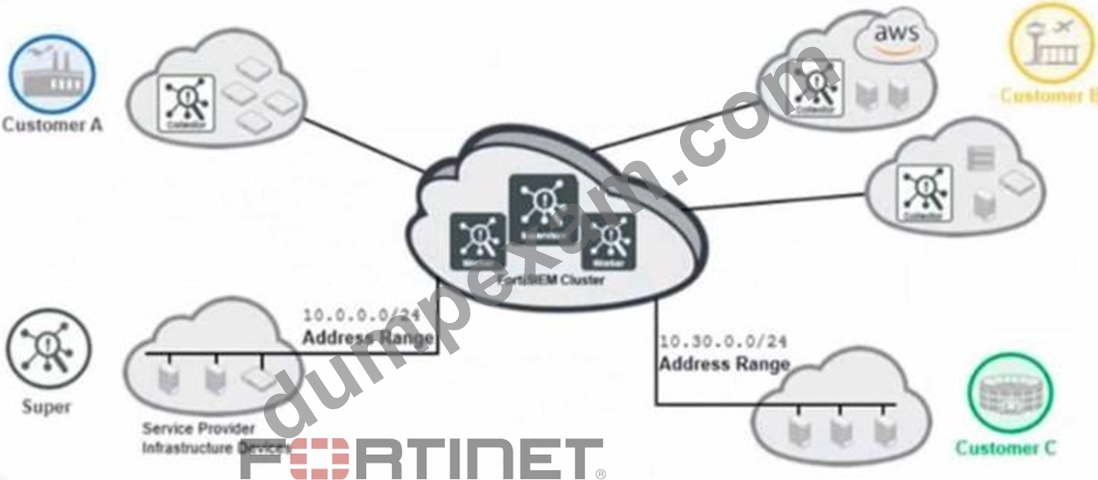
Which deployment type is shown in the exhibit?
- A. Service provider without collectors
- B. Service provider with collectors
- C. Enterprise cloud deployment
- D. Hybrid deployment with and without collectors
Answer: D
Explanation:
The exhibit shows a FortiSIEM cluster deployed in a multi-tenant service provider environment, serving multiple customers. The architecture includes:
1. Customers with Collectors
Customer A and Customer B (AWS) have collectors deployed within their environments.
Collectors gather and forward logs to the FortiSIEM cluster for centralized analysis.
2. Customers Without Collectors
Customer C does not have a collector; instead, it sends logs directly to the FortiSIEM cluster.
3. Super Organization Managing Infrastructure
The service provider infrastructure devices (e.g., networking and security appliances) are managed directly by the FortiSIEM cluster.
This mixed setup, where some customers use collectors while others send logs directly, represents a hybrid deployment with and without collectors.
NEW QUESTION # 46
Refer to the exhibit.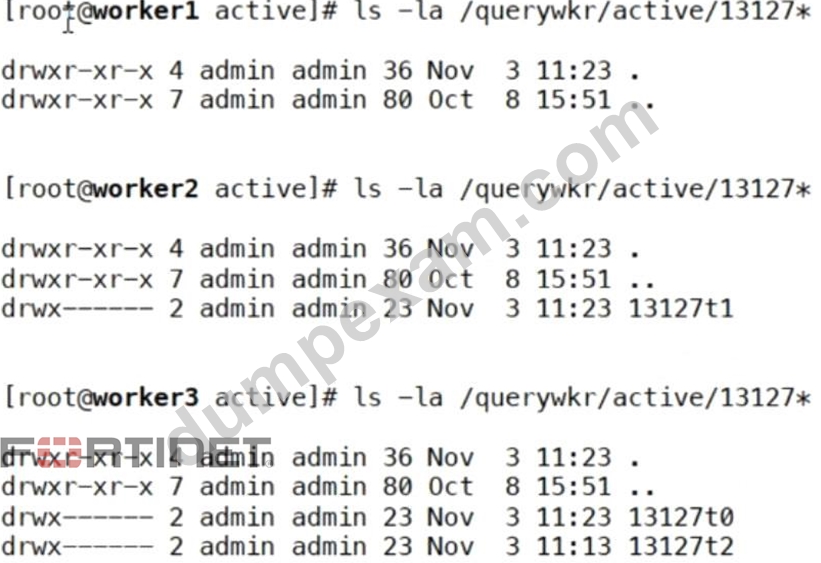
Which workers are assigned tasks for the query ID13127? (Choose two.)
- A. Worker1 has no tasks for query ID 13127*.
- B. Worker3 has two tasks for query ID 13127*.
- C. Worker3 has four tasks for query ID 13127*.
- D. Worker1 has one task for query ID 13127*.
- E. Worker2 has two tasks for query ID 13127*.
Answer: A,B
Explanation:
The exhibit shows the directory listings forthree different workers(worker1,worker2, andworker3) under the
/querywkr/active/13127*path, which indicatesactive query tasksassigned to each worker.
1.Worker1 (worker1)
The output doesnotshow any subdirectories or task files (13127t0,13127t1, etc.), meaningWorker1 is not assigned any tasks.*
2.Worker2 (worker2)
The output showsone task (13127t1)under/querywkr/active/13127*.
The workerhas only one assigned task, not two, so optionsC and D are incorrect.
3.Worker3 (worker3)
The output showstwo tasks (13127t0and13127t1), indicating that Worker3 is processingtwo tasksfor query ID
13127.*
NEW QUESTION # 47
One primary advantage of UEBA in FortiSIEM is:
- A. Designing a better user interface for administrators?
- B. Streamlining software update processes?
- C. Assisting in network device installations?
- D. Identifying potentially harmful activities that deviate from established patterns?
Answer: D
NEW QUESTION # 48
Which organization do agents belong to after registration? (Choose two.)
- A. The windows agents belong to the super organization.
- B. The agents belong to the organization specified in the agent installation setup wizard for Windows platforms.
- C. The agents belong to the organization specified in the command line parameters for Linux platforms.
- D. The Linux agents belong to the super local organization.
Answer: B,C
Explanation:
When registering agents in FortiSIEM, the organization to which they belong depends on how they are installed:
*Windows Agents
*During installation, the setup wizard prompts the user to specify the organization.
*This ensures the agent is correctly assigned to the organization defined during setup.
*Linux Agents
*Installation on Linux requires command-line parameters, including the organization name.
*This means that the organization is explicitly defined during the installation process.
NEW QUESTION # 49
Refer to the exhibit.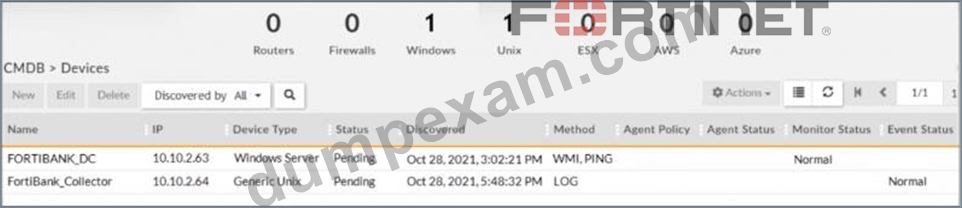
Why is the windows device still in the CMDB, even though the administrator uninstalled the windows agent?
- A. The device must be deleted from backend of FortiSIEM
- B. The device has performance jobs assigned
- C. The device was not uninstalled properly
- D. The device must be deleted manually from the CMDB
Answer: B
NEW QUESTION # 50
Refer to the exhibit.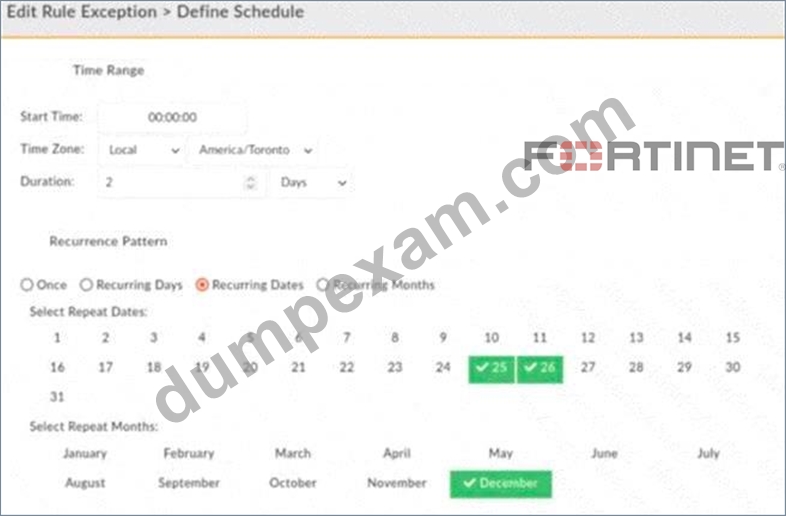
An administrator applies the rule exception shown in the exhibit.
How does this configuration impact the incident generation for that rule?
- A. Incidents will be generated without triggering an email alert during the specified period.
- B. Incidents will not be generated during the specified period.
- C. Incidents will be generated only during the specified period.
- D. Events will not be processed by the rule during the specified period.
Answer: B
Explanation:
From the exhibit, the rule exception is set for:
# Time Range: Starts at 00:00:00
# Duration: 2 days
# Recurrence Pattern: December 25th and December 26th
This means that during these two days (every year in December), the rule will not trigger incidents.
Rule exceptions temporarily suppress incident generation during the specified period.
Events are still processed, but no incidents are generated.
NEW QUESTION # 51
Refer to the exhibit.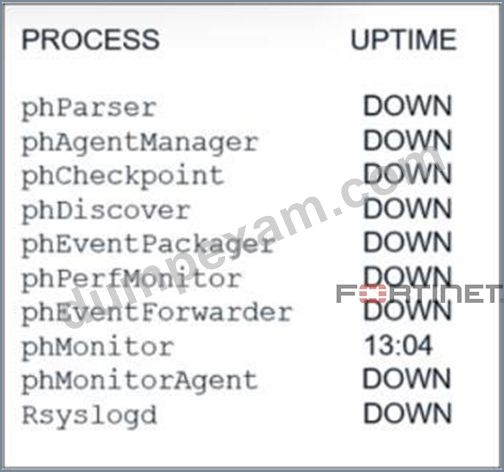
An administrator deploys a new collector for the first time, and notices that all the processes except the phMonitor are down.
How can the administrator bring the processes up?
- A. The administrator needs to run the command phtools --start all on the collector.
- B. The processes will come up after the collector is registered to the supervisor.
- C. Rebooting the collector will bring up the processes.
- D. The collector was not deployed properly and must be redeployed.
Answer: B
NEW QUESTION # 52
Which statement about EPS bursting is true?
- A. FortiSIEM will let you burst up to five times the licensed EPS once during a 24-hour period.
- B. FortiSIEM must be provisioned with ten percent the licensed EPS to handle potential event surges.
- C. FortiSIEM will let you burst up to five times the licensed EPS at any given time, regardless of unused of EPS.
- D. FortiSIEM will let you burst up to five times the licensed EPS at any given time, provided it has accumulated enough unused EPS.
Answer: D
NEW QUESTION # 53
Where are the SQLite databases that are used for the baselining, stored?
- A. /opt/phoenix/delta
- B. /opt/phoenix/cache
- C. /opt/phoenix/config
- D. /opt/phoenix/bin
Answer: D
NEW QUESTION # 54
Refer to the exhibit.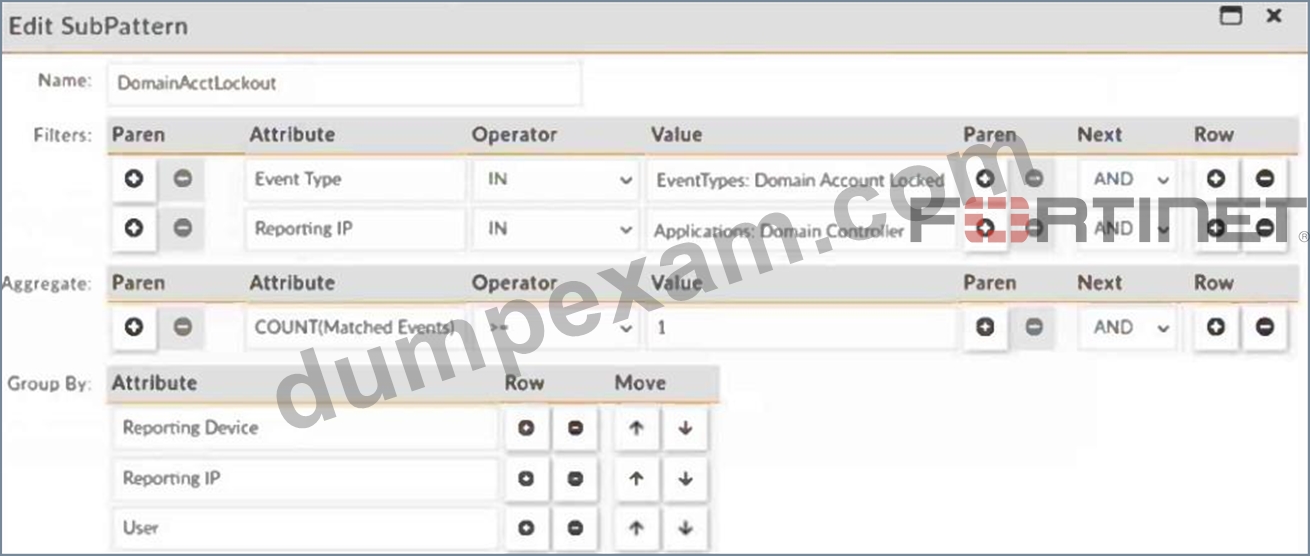
Which statement about the rule filters events shown in the exhibit is true?
- A. The rule filters events with an event type that belong to the Domain Account Locked CMDB group and a user that belongs to the Domain Controller applications group.
- B. The rule filters events with an event type that belong to the Domain Account Locked CMDB group and a reporting IP that belong to the Domain Controller applications group.
- C. The rule filters events with an event type that equals Domain Account Locked and a reporting IP that equals Domain Controller applications.
- D. The rule filters events with an event type that belong to the Domain Account Locked CMDB group or a reporting IP that belong to the Domain Controller applications group.
Answer: B
Explanation:
From the Filters section in the exhibit, we see:
1. Event Type IN EventTypes: Domain Account Locked
2. Reporting IP IN Applications: Domain Controller
3. Logical Operator: AND
Since both conditions must be true, the rule is effectively filtering events where:
*The event type belongs to the Domain Account Locked CMDB group
*The reporting IP belongs to the Domain Controller applications group
NEW QUESTION # 55
What is the disadvantage of automatic remediation?
- A. It is equivalent to running an IPS in monitor-only mode-watches but does not block.
- B. External threats or attacks detected by FortiSIEM will need user interaction to take action on an already overworked SOC team.
- C. Threat behavior occurring during the night could take hours to respond to.
- D. It can make a disruptive change to a user, block access to an application, or disconnect critical systems from the network.
Answer: D
Explanation:
Automatic remediation inFortiSIEMenablesreal-time responseto security threats without manual intervention.
While this can improve response times, it also introducesrisksbecauseactions are taken automatically based on predefined rules, without human verification.
# Automated responsescould mistakenly block legitimate usersfrom critical systems or applications.
#Misconfigured rulesmightdisconnect essential systems, causing business disruptions.
# If an incident isa false positive,automatic remediation may interfere with normal operationsunnecessarily.
NEW QUESTION # 56
In the context of FortiSIEM, agents are primarily tasked to:
- A. Ensure smooth communication between different tenants.
- B. Forward logs and events to the FortiSIEM solution.
- C. Act as a firewall and protect endpoints.
- D. Provide backup and restore capabilities.
Answer: B
NEW QUESTION # 57
Refer to the exhibit.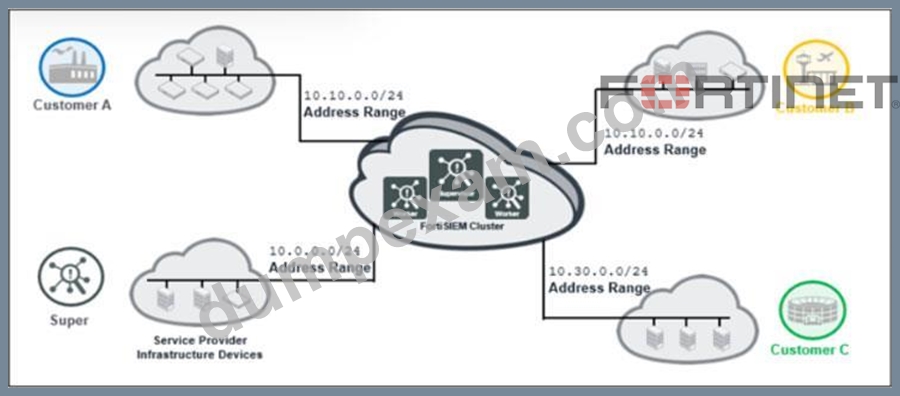
The service provider deployed FortiSIEM without a collector and added three customers on the supervisor.
What mistake did the administrator make?
- A. Collectors must be deployed on all customer premises before they are added to organizations on the supervisor.
- B. At least one collector must be deployed to collect logs from service provider infrastructure devices.
- C. The number of workers on the FortiSIEM cluster must match the number of customers added.
- D. Customer A and customer B have overlapping IP addresses.
Answer: D
NEW QUESTION # 58
Which of the following is a primary reason to deploy FortiSIEM agents on both Windows and Linux platforms?
- A. To provide redundancy in case one platform fails.
- B. To increase the speed of the SOC server.
- C. To prevent users from installing unauthorized software.
- D. To cover a diverse range of operating systems in an environment.
Answer: D
NEW QUESTION # 59
......
Fortinet FCSS_ADA_AR-6.7 Exam Syllabus Topics:
| Topic | Details |
|---|---|
| Topic 1 |
|
| Topic 2 |
|
| Topic 3 |
|
| Topic 4 |
|
Get Top-Rated Fortinet FCSS_ADA_AR-6.7 Exam Dumps Now: https://www.dumpexam.com/FCSS_ADA_AR-6.7-valid-torrent.html
Pass Your FCSS_ADA_AR-6.7 Dumps Free Latest Fortinet Practice Tests: https://drive.google.com/open?id=1CJi1MH-bw_wOlWUOd87DDvmkgiHtGkeR
