

New 2024 Realistic Databricks-Certified-Data-Engineer-Associate Dumps Test Engine Exam Questions in here
Updated Official licence for Databricks-Certified-Data-Engineer-Associate Certified by Databricks-Certified-Data-Engineer-Associate Dumps PDF
The GAQM Databricks-Certified-Data-Engineer-Associate (Databricks Certified Data Engineer Associate) Exam is designed for professionals who are interested in validating their expertise in building and managing big data processing systems using Databricks. Databricks is a unified data analytics platform that offers a cloud-based environment for processing big data workloads. Databricks-Certified-Data-Engineer-Associate exam covers a wide range of topics, including data engineering, data processing, data storage, and data analysis.
One of the unique features of the Databricks Certified Data Engineer Associate certification is that it is focused on Databricks, a cloud-based big data processing platform. Databricks is becoming increasingly popular among data professionals, and the certification is designed to test individuals' knowledge of this platform. This makes the certification especially valuable for individuals who work with Databricks or plan to work with it in the future.
The GAQM Databricks-Certified-Data-Engineer-Associate certification is an excellent way for professionals to demonstrate their competence and expertise in working with Databricks. Databricks Certified Data Engineer Associate Exam certification validates your knowledge and skills in designing, building, and maintaining data pipelines with Databricks, which is an essential skill for any organization that is looking to leverage big data for business growth.
NEW QUESTION # 34
Which of the following code blocks will remove the rows where the value in column age is greater than 25 from the existing Delta table my_table and save the updated table?
- A. UPDATE my_table WHERE age > 25;
- B. DELETE FROM my_table WHERE age <= 25;
- C. UPDATE my_table WHERE age <= 25;
- D. SELECT * FROM my_table WHERE age > 25;
- E. DELETE FROM my_table WHERE age > 25;
Answer: E
NEW QUESTION # 35
Which of the following benefits is provided by the array functions from Spark SQL?
- A. An ability to work with complex, nested data ingested from JSON files
- B. An ability to work with time-related data in specified intervals
- C. An ability to work with data within certain partitions and windows
- D. An ability to work with an array of tables for procedural automation
- E. An ability to work with data in a variety of types at once
Answer: A
Explanation:
Explanation
Array functions in Spark SQL are primarily used for working with arrays and complex, nested data structures, such as those often encountered when ingesting JSON files. These functions allow you to manipulate and query nested arrays and structures within your data, making it easier to extract and work with specific elements or values within complex data formats. While some of the other options (such as option A for working with different data types) are features of Spark SQL or SQL in general, array functions specifically excel at handling complex, nested data structures like those found in JSON files.
NEW QUESTION # 36
A data engineer has a Python variable table_name that they would like to use in a SQL query. They want to construct a Python code block that will run the query using table_name.
They have the following incomplete code block:
____(f"SELECT customer_id, spend FROM {table_name}")
Which of the following can be used to fill in the blank to successfully complete the task?
- A. spark.table
- B. spark.delta.sql
- C. dbutils.sql
- D. spark.delta.table
- E. spark.sql
Answer: E
NEW QUESTION # 37
A data engineer needs to create a table in Databricks using data from their organization's existing SQLite database.
They run the following command: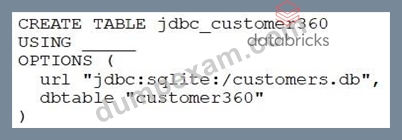
Which of the following lines of code fills in the above blank to successfully complete the task?
- A. org.apache.spark.sql.sqlite
- B. org.apache.spark.sql.jdbc
- C. DELTA
- D. autoloader
- E. sqlite
Answer: A
NEW QUESTION # 38
Which of the following describes a benefit of creating an external table from Parquet rather than CSV when using a CREATE TABLE AS SELECT statement?
- A. Parquet files have the ability to be optimized
- B. Parquet files can be partitioned
- C. CREATE TABLE AS SELECT statements cannot be used on files
- D. Parquet files have a well-defined schema
- E. Parquet files will become Delta tables
Answer: D
Explanation:
Explanation
https://www.databricks.com/glossary/what-is-parquet#:~:text=Columnar%20storage%20like%20Apache%20Par Columnar storage like Apache Parquet is designed to bring efficiency compared to row-based files like CSV.
When querying, columnar storage you can skip over the non-relevant data very quickly. As a result, aggregation queries are less time-consuming compared to row-oriented databases.
NEW QUESTION # 39
Which of the following statements regarding the relationship between Silver tables and Bronze tables is always true?
- A. Silver tables contain aggregates while Bronze data is unaggregated.
- B. Silver tables contain less data than Bronze tables.
- C. Silver tables contain a more refined and cleaner view of data than Bronze tables.
- D. Silver tables contain more data than Bronze tables.
- E. Silver tables contain a less refined, less clean view of data than Bronze data.
Answer: D
Explanation:
Explanation
https://www.databricks.com/glossary/medallion-architecture
NEW QUESTION # 40
A data engineer needs access to a table new_table, but they do not have the correct permissions. They can ask the table owner for permission, but they do not know who the table owner is.
Which of the following approaches can be used to identify the owner of new_table?
- A. Review the Owner field in the table's page in the cloud storage solution
- B. Review the Permissions tab in the table's page in Data Explorer
- C. All of these options can be used to identify the owner of the table
- D. There is no way to identify the owner of the table
- E. Review the Owner field in the table's page in Data Explorer
Answer: E
NEW QUESTION # 41
Which of the following Structured Streaming queries is performing a hop from a Silver table to a Gold table?
- A.
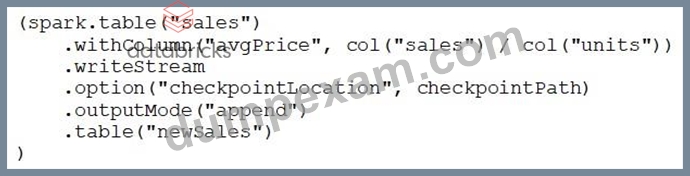
- B.
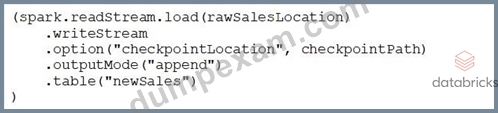
- C.
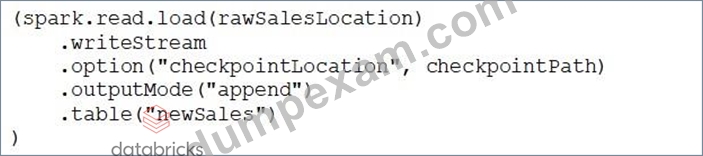
- D.
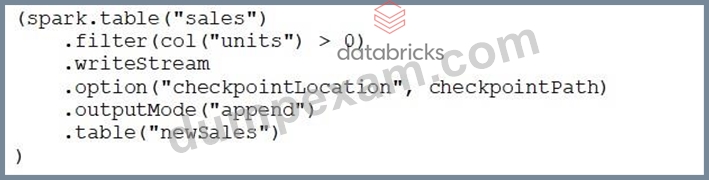
- E.

Answer: E
NEW QUESTION # 42
Which of the following describes the storage organization of a Delta table?
- A. Delta tables are stored in a collection of files that contain data, history, metadata, and other attributes.
- B. Delta tables are stored in a single file that contains data, history, metadata, and other attributes.
- C. Delta tables are stored in a single file that contains only the data stored within the table.
- D. Delta tables store their data in a single file and all metadata in a collection of files in a separate location.
- E. Delta tables are stored in a collection of files that contain only the data stored within the table.
Answer: A
NEW QUESTION # 43
A data engineer runs a statement every day to copy the previous day's sales into the table transactions. Each day's sales are in their own file in the location "/transactions/raw".
Today, the data engineer runs the following command to complete this task: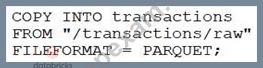
After running the command today, the data engineer notices that the number of records in table transactions has not changed.
Which of the following describes why the statement might not have copied any new records into the table?
- A. The previous day's file has already been copied into the table.
- B. The format of the files to be copied were not included with the FORMAT_OPTIONS keyword.
- C. The PARQUET file format does not support COPY INTO.
- D. The names of the files to be copied were not included with the FILES keyword.
- E. The COPY INTO statement requires the table to be refreshed to view the copied rows.
Answer: A
Explanation:
Explanation
https://docs.databricks.com/en/ingestion/copy-into/index.html The COPY INTO SQL command lets you load data from a file location into a Delta table. This is a re-triable and idempotent operation; files in the source location that have already been loaded are skipped. if there are no new records, the only consistent choice is C no new files were loaded because already loaded files were skipped.
NEW QUESTION # 44
A data engineer runs a statement every day to copy the previous day's sales into the table transactions. Each day's sales are in their own file in the location "/transactions/raw".
Today, the data engineer runs the following command to complete this task:
After running the command today, the data engineer notices that the number of records in table transactions has not changed.
Which of the following describes why the statement might not have copied any new records into the table?
- A. The previous day's file has already been copied into the table.
- B. The format of the files to be copied were not included with the FORMAT_OPTIONS keyword.
- C. The PARQUET file format does not support COPY INTO.
- D. The names of the files to be copied were not included with the FILES keyword.
- E. The COPY INTO statement requires the table to be refreshed to view the copied rows.
Answer: A
NEW QUESTION # 45
A data architect has determined that a table of the following format is necessary:
Which of the following code blocks uses SQL DDL commands to create an empty Delta table in the above format regardless of whether a table already exists with this name?
- A. Option D
- B. Option A
- C. Option C
- D. Option E
- E. Option B
Answer: D
NEW QUESTION # 46
A data engineer has developed a data pipeline to ingest data from a JSON source using Auto Loader, but the engineer has not provided any type inference or schema hints in their pipeline. Upon reviewing the data, the data engineer has noticed that all of the columns in the target table are of the string type despite some of the fields only including float or boolean values.
Which of the following describes why Auto Loader inferred all of the columns to be of the string type?
- A. There was a type mismatch between the specific schema and the inferred schema
- B. Auto Loader only works with string data
- C. JSON data is a text-based format
- D. Auto Loader cannot infer the schema of ingested data
- E. All of the fields had at least one null value
Answer: C
NEW QUESTION # 47
Which of the following tools is used by Auto Loader process data incrementally?
- A. Data Explorer
- B. Checkpointing
- C. Databricks SQL
- D. Spark Structured Streaming
- E. Unity Catalog
Answer: D
NEW QUESTION # 48
Which of the following describes a scenario in which a data engineer will want to use a single-node cluster?
- A. When they are manually running reports with a large amount of data
- B. When they are working with SQL within Databricks SQL
- C. When they are working interactively with a small amount of data
- D. When they are concerned about the ability to automatically scale with larger data
- E. When they are running automated reports to be refreshed as quickly as possible
Answer: C
Explanation:
Explanation
A Single Node cluster is a cluster consisting of an Apache Spark driver and no Spark workers. A Single Node cluster supports Spark jobs and all Spark data sources, including Delta Lake. A Standard cluster requires a minimum of one Spark worker to run Spark jobs.
NEW QUESTION # 49
A data engineer only wants to execute the final block of a Python program if the Python variable day_of_week is equal to 1 and the Python variable review_period is True.
Which of the following control flow statements should the data engineer use to begin this conditionally executed code block?
- A. if day_of_week == 1 and review_period == "True":
- B. if day_of_week == 1 and review_period:
- C. if day_of_week = 1 and review_period:
- D. if day_of_week = 1 and review_period = "True":
- E. if day_of_week = 1 & review_period: = "True":
Answer: B
Explanation:
Explanation
This statement will check if the variable day_of_week is equal to 1 and if the variable review_period evaluates to a truthy value. The use of the double equal sign (==) in the comparison of day_of_week is important, as a single equal sign (=) would be used to assign a value to the variable instead of checking its value. The use of a single ampersand (&) instead of the keyword and is not valid syntax in Python. The use of quotes around True in options B and C will result in a string comparison, which will not evaluate to True even if the value of review_period is True.
NEW QUESTION # 50
A data engineer needs to apply custom logic to string column city in table stores for a specific use case. In order to apply this custom logic at scale, the data engineer wants to create a SQL user-defined function (UDF).
Which of the following code blocks creates this SQL UDF?
- A.
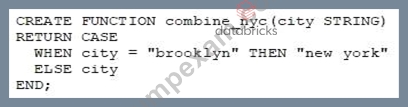
- B.
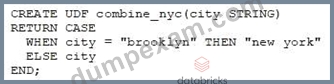
- C.

- D.
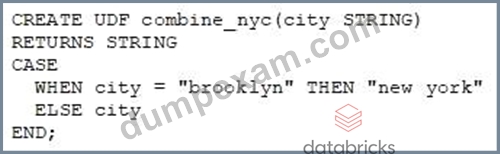
- E.

Answer: C
Explanation:
Explanation
https://www.databricks.com/blog/2021/10/20/introducing-sql-user-defined-functions.html
NEW QUESTION # 51
A data engineer has been using a Databricks SQL dashboard to monitor the cleanliness of the input data to an ELT job. The ELT job has its Databricks SQL query that returns the number of input records containing unexpected NULL values. The data engineer wants their entire team to be notified via a messaging webhook whenever this value reaches 100.
Which of the following approaches can the data engineer use to notify their entire team via a messaging webhook whenever the number of NULL values reaches 100?
- A. They can set up an Alert with a new email alert destination.
- B. They can set up an Alert without notifications.
- C. They can set up an Alert with a custom template.
- D. They can set up an Alert with a new webhook alert destination.
- E. They can set up an Alert with one-time notifications.
Answer: D
NEW QUESTION # 52
A data engineer wants to create a relational object by pulling data from two tables. The relational object does not need to be used by other data engineers in other sessions. In order to save on storage costs, the data engineer wants to avoid copying and storing physical data.
Which of the following relational objects should the data engineer create?
- A. View
- B. Delta Table
- C. Database
- D. Spark SQL Table
- E. Temporary view
Answer: E
Explanation:
Explanation
Temp view : session based Create temp view view_name as query All these are termed as session ended:
Opening a new notebook Detaching and reattaching a cluster Installing a python package Restarting a cluster
NEW QUESTION # 53
A data engineer needs to determine whether to use the built-in Databricks Notebooks versioning or version their project using Databricks Repos.
Which of the following is an advantage of using Databricks Repos over the Databricks Notebooks versioning?
- A. Databricks Repos allows users to revert to previous versions of a notebook
- B. Databricks Repos is wholly housed within the Databricks Lakehouse Platform
- C. Databricks Repos automatically saves development progress
- D. Databricks Repos supports the use of multiple branches
- E. Databricks Repos provides the ability to comment on specific changes
Answer: D
Explanation:
Explanation
An advantage of using Databricks Repos over the built-in Databricks Notebooks versioning is the ability to work with multiple branches. Branching is a fundamental feature ofversion control systems like Git, which Databricks Repos is built upon. It allows you to create separate branches for different tasks, features, or experiments within your project. This separation helps in parallel development and experimentation without affecting the main branch or the work of other team members. Branching provides a more organized and collaborative development environment, making it easier to merge changes and manage different development efforts. While Databricks Notebooks versioning also allows you to track versions of notebooks, it may not provide the same level of flexibility and collaboration as branching in Databricks Repos.
NEW QUESTION # 54
A data engineer has a Job with multiple tasks that runs nightly. Each of the tasks runs slowly because the clusters take a long time to start.
Which of the following actions can the data engineer perform to improve the start up time for the clusters used for the Job?
- A. They can configure the clusters to autoscale for larger data sizes
- B. They can use endpoints available in Databricks SQL
- C. They can use jobs clusters instead of all-purpose clusters
- D. They can configure the clusters to be single-node
- E. They can use clusters that are from a cluster pool
Answer: C
NEW QUESTION # 55
......
Grab latest Databricks Databricks-Certified-Data-Engineer-Associate Dumps as PDF Updated: https://www.dumpexam.com/Databricks-Certified-Data-Engineer-Associate-valid-torrent.html
Newly Released Databricks-Certified-Data-Engineer-Associate Dumps for Databricks Certification Certified: https://drive.google.com/open?id=1ljtZXMBwnG-XzPTHADDZXxSqEUoS1mnT
